Showing posts with label NERD POWER. Show all posts

Saturday, July 23, 2022

#ActuallyAutistic


Here’s what happened. 

Multiple people around me got diagnosed with ADHD, including one of my roommates. Watching their journeys, I saw a few things that I recognized. 

Object permanence problems. (If I can’t see a food item in the fridge, it does not exist. I have thrown away so many packages of cheese. And if I need to remember to bring something with me somewhere, I have to either leave myself a note or leave the item right by the door.) 

Bumping into things. All the time. My spatial awareness of my own body is shite. 

Hyperfixations. Having projects or TV shows or movies or hobbies that take up all of my mental time and energy for a significant period of time. Some could be considered specialized interests, since I’ve been obsessed with them for most of my life and have a considerable amount of knowledge about them. (Hey, ancient Egypt.) 

But as I learned more about ADHD, I kept bumping up against one particular idea: that people with ADHD often struggle with executive function. 
 
And I generally…don’t? When I’m in a bad depression dip, I struggle to function, but it’s not quite an executive function issue. It’s not that I have some block surrounding organization or task completion or even being overwhelmed. My block is surrounding energy. In fact, when people talk about how difficult it is to complete a task, I have a hard time understanding what they mean. You just…do it? 

So I was like, “Hey, internet, what has some of the symptoms of ADHD but you’re hella good at organizing things, breaking down a large task into smaller parts, and completing to do list items, and also were a weird kid who struggled with social cues?” 
 
Oh. 
 
Autism. The answer is autism, kids. 

So I had a crisis, because I couldn’t have autism. I hated math growing up, and I’m a deeply empathetic person who’s sensitive to the feelings of those around me, and I actually have lots of friends now, and I understand humor and metaphors. So there’s no way I could be autistic. 

And then I took the RAADS-r test and scored an 83. The minimum score for autism is 65. So I took another test from The Autism Research Centre in Canada, and scored a 30, which is at the low end of high risk. 

And then, based on the RAADS-r questions, I started really looking at myself, and who I was as a kid, and who I am now. A fearless moral inventory, if you will. 

And the truth is that I really was a pretty weird kid. I never quite fit in…I always felt different from other people, and most of the time, that was fine with me. But here is a short list of the ways I was weird, which are all also autistic traits: 
  • I was very very anxious about food. I was a very picky eater, refused to try new foods, and had an enormous irrational meltdown if someone tried to get me to eat something I didn’t like or hadn’t tried before. 
  • I often wore the exact same thing every day for days and days (and weeks?) on end. For like, a long time. For at least the first half of my freshman year of high school, I wore the same jeans, off-white textured top, and blue cardigan. Every day. 
  • I played imagination games (dress up, Barbies, dolls/stuffed animals, etc) for longer than average. (I think.) Until I was 14 or so. 
  • I refused to put my head underwater at the pool. I remember a swim teacher specifically giving me this note at the end of several weeks. She might have even bribed me with candy? I also remember having similar anxieties about having my hair washed. 
  • Hygiene in general was difficult, because of what I now understand to be sensory issues. I often refused to brush my hair, and would get these awful, matted rat’s nests in my hair as a result. I struggled with brushing my teeth, especially spitting the toothpaste out. 
  • In general, I struggled a lot socially. Some of that also probably had to do with the hygiene and outfit things I just listed, but even aside from that, I often just couldn’t connect to my peers. I had a hard time accessing what was “cool” or “popular.” It all seemed so arbitrary to me, and I couldn’t keep track of it, and couldn’t figure out what was important or why. I was teased and picked on, sometimes by people whom I had thought were my friends. I often had a sense of having missed something in social interactions…I could feel the temperature change in a conversation, but I wouldn’t know why or what had happened. I disappeared into books for much of my childhood, and preferred to spend recess in elementary school making daisy chains by myself to playing with my peers. Freshman year of high school, I often sat in the hallway above the auditorium and read books during lunch. Granted, I wasn’t a complete loner. I did have friends and meaningful connections, but for a long time, they were all just as weird (and probably as neurodivergent) as I was. 
 
And you guys. Most of these things were going on well into my teenage years. It took me finally getting into theatre my SOPHOMORE YEAR IN HIGH SCHOOL to feel like I could finally start to fit in with my fellow humans. 
 
(I have a theory about why—I think it’s because theatre kids are VERY EXPRESSIVE and direct, and I could easily navigate conversations that were with people who were weirdos but also clearly expressing emotions in very dramatic ways. Like, weirdness was embraced among theatre kids. And everyone was so dramatic, which meant social interactions were less subtle. And scripts gave me parameters to interact within. I could make strong individual choices, but there was always a “right thing” I could say when following a script onstage. It was enough to give me confidence to develop those skills more as a person offstage.) 
 
But you grew out of all of it, right, Liz? 
 
Here is a short list of the ways I continue to be weird, most of them starting in childhood but continuing on today, all of which are really common traits among those with autism: 
  • I’m still a picky eater, tbh. Spicy foods make me feel like I’m dying, and new foods give me anxiety, and if a food has a texture I dislike, it makes me gag. 
  • My most prevalent stim is twirling my hair, followed closely by picking at my nails and swaying while standing. I often use fidget toys during movies or plays to keep myself from stimming hard in other ways that are more damaging (like making my cuticles bloody with picking at them). 
  • Little spoons only. I am picky about silverware and dishes in general. They must be the right shape, weight, material, etc. 
  • Form follows function when it comes to clothing. If it’s not comfortable, I cannot stand to wear it. I often cut tags out of my shirts, and have occasionally cut collars on t-shirts to be lower so that they weren’t as close to my neck. I’ve been known to trim scratchy inner hems. I dislike wearing pants (as any of my previous roommates can attest), and I dislike wearing shoes (as anyone who knows me can attest). 
  • Eye contact actually doesn’t come easily to me. It’s much easier onstage, but in real life, I have to remind myself to consciously do it during other interactions. I also have to consciously remind myself of the rules of casual conversations, especially if it’s with someone I don’t know super well. (If they ask you how your day was, ask them the same thing back. Conversation is reciprocal. And also, not everyone is interested in the random trivial fact you learned on a podcast today.) 
  • In fact, I uh…I rehearse social interactions ahead of time. For a long time, one of my deepest secrets was that I’ve rehearsed jokes or stories or conversation bits before telling them for like, most of my life. I’m only comfortable sharing this now because I’ve learned that lots of other people do it. 
  • I have a list in my phone of conversation starters and reminders to help me navigate social situations where I don’t know people as well. Topics to bring up, questions to ask, etc. 
  • I’m easily overwhelmed in loud, crowded areas. When I’m sitting in a theatre before a show (as an audience member), I usually have to put in headphones and play white noise to keep me from like, freaking out. I’ve also used headphones and white noise in grocery stores, on public transportation, and in airports. 
  • Repeated soft touch on one part of my skin sometimes feels actually and literally painful. One or two brushes of someone’s fingers over one part of my arm = lovely. Repeated touch of the same kind in the same place = torture. 
  • Spontaneous social interactions are hard for me. 99% of the time, I need a day to sort of emotionally prepare. It’s not that I don’t love people, it’s just that 1, the disruption in my plan for the day is difficult, and 2, social interactions take a lot of work for me and it’s hard to jump in really quickly. 
  • Walking on my tiptoes. I don’t do this one quite as much nowadays, but I often walk on just the balls of my feet. 
  • Always using movie/YouTube/TV/TikTok/etc quotes in conversations. (Or, more often, thinking them and not saying them, because if people don’t know the reference, it often gets in the way of actually connecting with other people, which is the goal of conversation. And also because I don’t know how to explain that the thing I just said is a reference to the blooper reel from an early 2000s British sitcom that I’ve watched dozens of times with my sister.) 
 
There are also a few things that could be classified as just kind of quirky personality traits, but I see them in a new autistic light nowadays. My deep love for forms, spreadsheets, taxes, and organizational documents of any kind. The meticulous tidiness of my room and/or desk. The game I play in my head when I’m buying something less than $20, when I try to think of a historical event that took place in the year of the total. ($14.92 = Columbus sailed the ocean blue.) 
 
I also have a few common morbidities with autism. I have an auditory processing disorder and misophonia. And hooo, boy, do I have a history of anxiety and depression. 
 
And each of these things on their own are kind of just quirky personality things, but put altogether, it looks a hell of a lot like autism. 

(Okay, quick note: Most of what I've described would have been classified in the past as Asperger's Syndrome, which is now recognized as just part of the autism spectrum. The autism spectrum doesn't mean every person is somewhere on a scale from "not austic at all" to "totally autistic." The autism spectrum means that either you're autistic or you're not, but if you are, there are a spectrum of experiences and supports needed. I have low to medium support needs, where someone else may have more support needs.)
 
I’m a little uncomfortable calling myself autistic without an “official diagnosis.” But it’s not like I took one BuzzFeed quiz and decided I was autistic. I’ve spent months reading articles, visiting websites, using diagnostic tools like the RAADS-r test, listening to other adult women with autism, and speaking about it with other autistic folks. 
 
I’m currently in the process of seeking a formal diagnosis, which is…difficult. One of the clinics I called is booked until the year 2024. And women who can mask their symptoms and have lower support needs are often dismissed or overlooked, so I want to find someone who specializes in autism in adult women, which is not easy. I also understand that if I am not diagnosed as autistic, that could also be accurate. It just…it really seems like an accurate diagnosis to me. 
 
When I told my roommate some of these things that I did and still do, she looked at me incredulously and asked “How did you not know?!” And I replied that I didn’t know because I’ve never been in anyone else’s head! I’ve only been in mine! And also I was born in 1985 and getting an autism diagnosis as a girl in the 1990s was unheard of! 
 
So now, at age 36, I’m navigating the very high possibility that I’m a little bit autistic. My therapist pointed out that I managed to white-knuckle my way through a lot of distress in order to have connection with my fellow human beings, and that I was able to find some helpful coping mechanisms just on my own. That’s worth celebrating. 
 
Does this change anything about my life now? Not really. 
 
Just kidding, I’ve been going through ongoing loops of identity crises, research and self-education, and re-evaluating every single aspect of my life. This also means that all of the social confidence I’ve developed over the last 20 years has frayed at the edges a bit. By my senior year of high school, I’d become confident enough that I could enter into social interactions with very little anxiety. A lot of that anxiety came back after getting divorced in 2017, but nowadays it’s like…middle school level social anxiety, 60% of the time. I’m hyper aware of how I act in every interaction I have with other human beings, while it’s happening, which means that the interaction itself sometimes gets weird because I’m aware of how I act and it’s just a strange, endless loop. 
 
Shout out to anyone who has become friends with me over the past six months or so. 
 
“But Liz, you don’t seem autistic at all!” Maybe not on the outside, I don’t. And maybe not to you. That’s probably because I’ve spent the last 20 years learning and practicing normalcy really really hard. (Also, I thought the same thing but then I learned more about autism.) 
 
But here are a few of the good things that have come from this journey. 
 
I have enormous compassion for little Liz. That weird girl with un-brushed hair who was reading by herself throughout school was doing the best she could with what she had, and no one had the tools or knowledge to help her navigate a world that presented challenges for her. I see her isolation and confusion and pain in a different light, and now I can reach back through time and offer so much love and patience to that young girl. 
 
And some of that sense of isolation has been lifted as well. When I first began my journey with a possible autism diagnosis, I felt this strange sense that the diagnosis would erase my experiences growing up. Like if I was autistic, I was just like a bunch of other people, instead of an unusual, otherworldly creature who single-handedly figured out how to connect to others on her own terms and was more highly evolved than her peers in middle school. I had come to embrace my strangeness as something beautiful that I then grew out of. But nowadays, I see things differently. I can still be an unusual, otherworldly creature…it’s just that now I don’t have to be alone in it. I get to keep the strangeness, but let go of the isolation. (I also now understand that I’m no better or worse than my peers…we just had different tools and experiences.) 
 
And I’ve seen this as an opportunity to embrace my strangeness and my needs. I follow a couple on TikTok who both have autism, and they posted a video about how one day, they just decided to be themselves, in all their strangeness. To not hide their wild, unusual quirks, and to live bravely as exactly who they are. Hearing this didn’t change a lot about my behavior, but it lifted a lot of the shame and embarrassment I had about my behavior. Okay, so I need some time to prep for social interactions! That’s a legitimate need and not a character flaw. So I’m a picky eater. So certain kinds of touch are painful to me. So I need headphones to help me not meltdown in large, noisy crowds. ALL OF THAT IS FINE. I’m allowed to have those needs and to speak them and to do what I can to meet them. 
 
And that’s actually true whether or not I get an official autism diagnosis from a licensed professional. That’s true of all of us. We’re allowed to give ourselves tools to navigate the things in the world that don’t work for us. We’re allowed to look back in time on our younger selves with compassion. We’re allowed to like what we like and dislike what we dislike and be our weirdest selves. 
 
Connection with our fellow human beings is still possible when we do those things. And the more we are our truest selves, the more authentic that connection will be.

Monday, June 15, 2020

You can't choose your race, but you can choose your class


Welcome to the campaign!*

We're playing a long-term game of Dungeons and Dragons here, and if you're new, there are a few things you should know. 

First, we have to function as though there's no Dungeon Master. (Or if there is, we don’t know who they are, but that gets into a whole ‘nother thing, so.) We’re all just going for it with the information we have. 

Second of all, we’re a big group of adventurers with different priorities, but in general, we’re fighting for social justice. We often come together to work on a specific campaign or battle. (For example, right now, in June of 2020, a big group of us is focusing on racial justice.) 

Third of all, unlike real DnD, you don’t have to stick with one class if you don’t want to. You can choose a different class each day, or overlap which class you’re a part of at any given moment. 

Okay! Ready to join? Here are the classes you can choose from: 

Fighters
Probably the largest and most visible class. These are the folks who march, carry signs, attend rallies, who are vocal on social media. 

Barbarians 
Warriors whose rage fuels them to (often violent) action. Throwers of bricks, topplers of statues, and painters of graffiti. They primarily fight for causes by disrupting the economy. These folks are definitely valuable to any cause, although some argue that too many on your team can become a liability. 

Monks and Paladins 
These folks focus on the spiritual and emotional aspects of the fight. These are the psychologists, the writers, the podcasters, and the friends reminding you that it’s okay to take a break. They provide a good balance for the fighters and barbarians. 

Bards 
The artists who use their art to critique the social order and provide hope for those fighting for change. Singers and songwriters, painters and other visual artists, theatre companies, TV and filmmakers, and creative writers. 

Clerics and Druids 
The healers and suppliers. They support the fighters during rallies and protests by providing medical care, food and water, transportation, and protection. This can sometimes be a dangerous job, but their involvement makes a huge difference at large protests. They’re the ones with first aid kits and bottles of water.

Rangers 
These folks are fighting on the fringes, having tough conversations with friends, family members, and acquaintances. Rather than participating directly in rallies and protests, they work to challenge the status quo wherever they are. This work isn’t as visible, but it’s deeply meaningful, and crucial to any social justice movement. 

Rogues 
The folks who use subversive tactics to fight against “enemies” of the movement. The internet group Anonymous is the perfect example. Standard tactics include things like hacking social media hashtags (like when KPop fans started using #WhiteLivesMatter to flood social media with KPop instead of white supremacy), crashing websites, sending memes to surveillance apps/sites to drown out any actual surveillance, and doing otherwise generally “legal” activity to stop immoral activity. 

Casters and Support Casters: Sorcerers, Warlocks, and Wizards 
These folks take direct action through donating, calling representatives, showing up at government meetings, voting, drafting letters, etc. These folks do the work “on the ground” even when there isn’t a protest or news story. Consistent ongoing work is key here, and it’s often most effective when you prepare a specific spell to utilize. 

Monday, January 7, 2019

Hardcore Handicrafts

Okay, so part of this entry is a shameless plug. I just opened an Etsy shop of subversive cross stitches and I want everyone to buy things from it. BUT, I also wanted to talk about the kick-ass history of “craftivism,” and of people (especially women) using traditionally feminine art forms to make their voices heard. Because it’s pretty rad. So here.

Three Awesome Ways That Crafting Has Been Used To Fight “The Man”:

1. Allowing people to take economics (and politics) into their own hands.

During the American Revolution, women often made their own clothes and spun their own yarn, but not necessarily just because it was the 1700s. You could buy clothes and yarn in shops all over America, but here’s the kicker—they were all British imports. By making their own cloths, yarn, and textile goods, women were hitting England where it hurt most…its pocketbook. It was just one more way Americans were declaring their independence.


Mahatma Gandhi used a similar tactic during India’s fight for independence. He encouraged the people of India to spin their own thread, rather than buying it from British imperialists. But for Gandhi, the spinning wheel was also a powerful symbol of claiming power non-violently. The act of spinning itself was meditative, and it was a way to show that the people of India could be self-sufficient. By spinning their own thread, they were both hitting British pocketbooks, and sending the message that Britain wasn’t needed. (This is why India’s flag features a spinning wheel.)

And as the punk rock scene (and then like, a bunch of other scenes) has been showing us for decades, making your own stuff is a way to fight corporate greed. It keeps money in the hands of individuals and small business owners, printing T-shirts in basements and hand-drawing posters. If you disagree with the way that large corporations are run, making your own promotional materials is a pretty rad way to show those large corporations that you don’t need them.

2. Giving people a safe place to gather for political meetings.

Who would suspect a group of women gathered in a parlor, knitting socks and hemming quilt squares? It’s just women’s work. Surely they just talk of hats and recipes, not anything radical like the abolition of slavery! Well, joke’s on you, Patriarchy, because that’s exactly what women did for decades. It was difficult, if not impossible, for a woman in the 1800s to host a meeting of abolitionists in her home. Nor could they easily meet elsewhere, without ruining reputation and having to fight sexism ON TOP of racism.

But women found that when they gathered to spin thread, or quilt, or knit, or crochet, or do embroidery, they were left alone. So they used those opportunities to make plans, discuss activism, and create change.

Eventually, these groups started using their handicrafts to raise money for anti-slavery efforts, and began including poems and images to further their cause.

3. Make powerful political statements.

There are so many awesome examples of this, but here are a few of my favorites.

WOMANHOUSE
In late 1971, two female art teachers got real tired of women not being taken seriously in the art world. So they set up a “room of their own” by renovating a California mansion and inviting a bunch of women artists to create installations and performance pieces highlighting women’s experiences. They took a traditionally female space (“the home”) and filled it with all of this thought-provoking feminist art.

Faith Wilding’s “Crocheted Environment,” which is this fascinating combination of a spiderweb and your grandmother’s comforting pillows.

THE AIDS QUILT
In the mid-1980s, activist Cleve Jones got the idea for a quilt of panels with names of those who had lost their lives to AIDS. The response was immediate and enormous, and in 1987, the finished quilt was displayed on the National Mall in Washington. It was the size of a football field and contained 1,920 panels. It was taken to cities throughout the U.S., where more panels were added as money was raised for AIDS research and care. Today, it contains more than 48,000 panels, and similar quilts have been created all over the world.


PUSSY HATS
I still don’t like talking about the November 2016 election and what it meant. But damn if women didn’t SHOW UP to say something about it a few months later. A couple of women in a crocheting class got to talking about their activism and created the now famous pink pussy hat, versions of which were worn by thousands of women across the country in January of 2017. It’s become a powerful symbol of owning womanhood and refusing to be silenced.


My own lil etsy shop ain’t quite the same as an AIDS quilt or installation piece in a Victorian mansion. But I love feeling connected to all of the folks who’ve come before me, needle and thread in hand, ready to change the world. Athena may be the ancient Greek goddess of weaving and handicrafts, but damn if she ain’t the goddess of war, too.


Further reading
Buzzfeed: History of Craftivism
The Woven Road
Medium: Craft's Long History In Radical Protest Movements
Lithub: Ancient Origins of Feminist Craftivism
Timeline: Craftivism, Art, Women
PBS: Knitting Activism
Time: Craftivism Protest
The Wire: Ghandi and the Spinning Wheel
Womanhouse
Aids Memorial Quilt
Pussy Hat Project

Monday, September 17, 2018

Anxiety Puzzles


It’s a full two weeks since Episode 31: Anxiety Attacks! of “Mormon and the Methhead” aired, but it’s taken me that long to gather and write my thoughts. (And I felt really good about them, and then I had a session with my therapist that made me think, “Huh, maybe I’m not the best person to be writing about this?!” But then I decided, “Screw it, I’ll share my thoughts anway.”)

If anxiety attacks are a puzzle to be figured out, then I’ll share the box my own anxiety puzzle came in, so you can look at the picture and see if it helps you figure out yours.

Disclaimer: I’ve figured out a lot of my own anxiety puzzle with the guidance of a few good books, several classes on psychology and brain function, lots of internet research, and hours and hours of therapy. But I’m no therapist myself. Take what resonates with you and discard the rest.

Okay.

Some Stuff About Brains: The Physical and The Mental

There are two elements to all emotions: the physical (the things happening in our bodies) and the mental (our thoughts).

The physical elements of anxiety happen to us because our dumb caveman brains are overly enthusiastic about keeping us safe. The oldest and deepest part of our brain has one job: KEEP HUMAN ALIVE. So if it senses a threat, it amps up cortisol and adrenaline, which would normally be super helpful if we actually had to fight, flight, or freeze. Those chemicals strengthen our muscles and heighten our awareness, in case we need to run away or throw a punch or stay still so a predator doesn't see or hear us.

Our brains are filtering through a ton of information from our senses all the time—smells, tastes, colors, microexpressions, movement, etc. In neurotypical brains, all of this information goes into the subconscious and gets sorted into “important” and “not important” information. If it notices that an important thing might be a danger, it sets off those fight/flight/freeze chemicals.

The problem is that our brains aren’t super great at detecting what’s an actual threat and what isn’t. It wants to KEEP HUMAN ALIVE. So sometimes it just “plays it safe,” and gives us that burst of chemicals just in case. And we end up with shortness of breath, muscle tension, increased heart rate, etc. even if we’re not in actual danger.

For people with anxiety, it’s like this: if one time you got food poisoning from a red apple, your brain now automatically assumes that anything red is poisonous. Which is not true, of course, but bless our brains for trying.

Also, this might sound a little “jiggy-woo-woo,” but sometimes we experience anxiety simply because we sense other people are. For example, empaths are people who are highly tuned in to the emotions of others. The scientific explanation is that they subconsciously tend to notice breathing and microexpressions and even the smells of other people, and mirror them. This makes sense—it’s a little gift from evolution. If someone near is us being threatened, it’s helpful for our brains to notice so that we can protect ourselves, too. So if we can’t find the trigger for our own anxiety, it might be because there isn’t one—we’re just picking up on someone else’s. The New Age-y explanation might use words like “frequency” or “vibration.” Some people “pick up” on those frequencies. And sometimes all of this happens in our conscious minds, and sometimes it doesn’t.

Which brings me to the second element of anxiety: our thoughts. These are all the things going on in the conscious mind. Most people have a sort of “inner monologue” going on—it’s like that deep, threat-finding part of the brain is whispering a bunch of warnings to us. But it does it in first person because it’s an asshole. Everyone’s inner monologue is different, and it’s not like hearing voices, but it may say things like, “What if I lose my job? What if no one loves me? He probably doesn’t think I’m funny. She probably thinks I’m a slut. I’m messing up as a parent.”

So if anxiety has both a physical and mental elements, then for most people, the trick to combating anxiety is to interrupt the physical pattern AND interrupt the thought pattern.

Interrupting the Physical Pattern

There are a lot of different ways to help your body calm the hell down. (These are also helpful if you tend to “disassociate” or have the sensation of “leaving your body” in stressful situations.) Here are a few ideas:

1. Breathing.
There are tons of different breathing exercises you can do to help you bring your body back to stasis. A simple one is breathing in through the nose for 3 counts, holding for 3 counts, breathing out of the mouth for 6 counts, holding for 3 counts, and repeating. Or you could simply take a moment and notice your breath. Just pay attention to it, whatever it’s doing.

2. Do something physical.
Give your body some strong sensory information that it has to process. Run your fingers over the teeth of a comb, toss something from one hand to the other, take off your shoes. Stand up and stretch. Dance. Paint.

3. Tune in to your senses.
Take a moment and be still in whatever room you’re in. Then name 3 things you see, 3 things you hear, 3 things you feel, 3 things you smell.

4. Bilateral stimulation.
This is a fancy word for any rhythmic back-and-forth movement between the left and right sides of the body. Walking left, right, left, right. Or tapping your thighs, left, right, left, right. For some reason, this helps calm the nervous system. Therapists use this in a type of treatment called EMDR (Eye Movement Desensitization and Reprocessing). When your body is experiencing this left-right stimulation, it’s easier to deal with distressing thoughts.

Interrupting the Mental Pattern

The actual scientific name for this is “Cognitive Behavioral Therapy,” or CBT. It basically has 2 steps: identifying the malicious thoughts and countering them with different thoughts. (For a great resource on this, I highly recommend The Anxiety and Phobia Workbook. Changed my life, and I mean that literally.) Identifying thoughts just takes some practice. Countering them is having statements at the ready to keep those thoughts from spiraling. The best counter-statements are positive statements that directly address the malicious thoughts.

You’re basically using your conscious brain to talk back to that inner monologue. For example, here are some common thoughts people have in times of anxiety, and some counter-statements.

Anxiety thought: OMG WHAT THE HELL I’M FREAKING OUT.
Counter statement: This will be over soon. My body is just doing its job.

Anxiety thought: WHAT IF I LOSE MY JOB?!
Counter statement: I will always be able to find work.

Anxiety thought: I’M MESSING UP AS A PARENT.
Counter statement: I’m doing the best I can. My kids will figure things out, just as I figured things out.

Anxiety thought: THIS IS NOT WHO I AM I AM STRONGER THAN THIS.
Counter statement: This is something I am experiencing and it will be okay. There will always be people who love me.

The ultimate counter-statement is “I can handle it.” Because really, at the heart of every single fear we have is the fear “I won’t be able to handle it.” (That bit of wisdom is from another great book with a cheesy title, Feel the Fear and Do It Anyway.) You can write these things down, post them around your house, keep them in a card in your wallet. The more accessible, the better.

Additional Coping Strategy: Being Zen About It

I’ve been hella into mindfulness lately. The basic idea behind mindfulness is to simply tune in and observe your experience and the world around you, without judgment, without trying to change anything about it. To practice just being in the moment. You can picture your thoughts as cars on a street, and you’re just watching them drive by. You may be tempted to run out and intervene, or get interested in where they’re going, but you can practice just watching them pass by.

And it does take PRACTICE. But there are a bajillion apps and books and audiobooks and websites and classes and resources to help you learn and practice. (I recommend the app Headspace—I’m a big fan.)

I was in a group therapy session once where someone shared the advice to keep your mind and your ass in the same room. It was a pithy way of saying that it’s good to reflect on the past, and it’s good to plan for the future, but sometimes you have to stop and say to yourself, “Hey what room is your ass in?” (A Noodles & Company in Salt Lake City.) “ Okay, now get your mind in the same room.” (Mindfulness exercises ensue.)

Final Thoughts

If you’re having trouble with shame surrounding anxiety, you can think of it as a purely chemical reaction. Just as people with diabetes have bodies that don’t make enough insulin, your body makes too much cortisol and adrenaline. You don’t have control over it, just like people with diabetes don’t have control over how much insulin they produce. Emotions like anxiety aren’t necessarily good or bad. They just are.

For me, sometimes it’s also helpful to think of strong emotions as little kids. Sometimes they tug on our sleeves, ask for our attention, talk to us when we’re trying to do something else. And sometimes, we can turn to them and say, “Hey, I love you. You’re okay. I’m doing something else right now, so you can go play.” And they do. But sometimes they’re like “HEY I’M BLEEDING PLEASE HELP ME.” In those times, you can hit the pause button on whatever you’re doing, and do whatever self-care stuff you gotta do to get yourself back to equilibrium. This isn’t always possible in your circumstances, in which case, you can do a few of the above exercises until you have time to sit down and write or paint or run or do whatever it is you do to cope. (This analogy is also really helpful in difficult conversations, conflicts, or fights. Sometimes you gotta go take care of the emotional children before you can keep talking with a fellow grown up.)

If you want to plug all of this in to Jessa’s video game analogy/metaphor/theory/I-don’t-know-what-to-call-it, here’s how I’ve been thinking of it. Jessa said that our bodies—the avatars we’re using to play this game—have their own artificial intelligence. That’s the part of the brain that’s running the program KEEP HUMAN ALIVE. Which totally makes sense. We can’t play the game if we’re dead. That AI is the thing releasing those anxiety chemicals, and it’s just running its program.

But we, our highest selves, can run programs as well. We can run ADJUST BREATHING or MINDFULNESS or SELF-CARE. It doesn’t change the fact that our overprotective AI is gonna keep running KEEP HUMAN ALIVE. We actually do want it to run that program. But when it interrupts our lives, it’s helpful to have a few programs of our own.

Wednesday, June 28, 2017

What are you doing August 21, 2017?

If you live in the United States and your answer is anything other than "watching the total solar eclipse," I'm gonna say you need to change your plans.

Here's why this whole thing is so awesome.

First of all, it's a cosmic coincidence that total solar eclipses happen AT ALL. Our sun just happens to be 400 times bigger than the moon, but it also just happens to be 400 times farther away from us. So from our point of view on earth, they appear to be exactly the same size. The moon passes between the sun and the earth, causing a total solar eclipse, fairly often...it's visible from some point on earth about once every 18 months. But the path of totality crossing the United States? That's a little rarer. The last time it happened was in 1979, and it won't happen again until 2024.

So where's it gonna be visible? HERE:


That grey band is where you gotta be to see totality. You'll still get a pretty good show elsewhere (check out this guy's site for more info), but it's less than a day's drive to get to the path of totality from just about any point in the U.S. So I say go for it! Carpe diem, people!

Although...two warnings. Number one, don't look at the eclipse without eye protection. You can suffer serious permanent eye damage from looking directly at the sun, even when it's partially blocked by the moon. You can get special "eclipse glasses" for hella cheap on Amazon, though (pack of ten for $10). Regular sunglasses won't cut it. Number two, hotels and campsites along the path of totality are BOOKED SOLID, and have been for months. Because big space nerds like me plan their entire year around this.

BUT JUST CHECK OUT WHAT WE HAVE TO LOOK FORWARD TO!
Here's what will happen in the path of totality on August 21st, 2017, over the course of about half an hour. (DON'T FORGET TO WEAR ECLIPSE GLASSES!)

First Contact
As the moon starts to move in front of the sun, it will appear to take a little tiny bite out of it. You'll be able to see this with a telescope before you can see it with the naked eye.

Crescent projections may possibly be seen on various surfaces
As more of the sun is covered, it will look like a crescent. If you happen to be near some trees or other vegetation, look on the ground. The spaces between the leaves create a "pinhole camera," projecting images of the solar eclipse on the ground. You can also create this same effect by making your own pinhole projector--just punch a tiny hole in a sheet of paper or cardboard.

Changing light
The light will become noticeably dimmer. You may even notice a strange or eerie "tint" to the light as more of the sun is blocked, and colors will appear washed out.

Strange animal behavior
If you happen to be near wildlife, you may notice some changes in behavior. Animals don't keep calendars of solar eclipses (that we know of), so they interpret the darkening light as oncoming twilight, and may either settle in for the night, or get up and start their nocturnal activities. (Joke's on you, fauna!)

Sharpening shadows
Because of the angle and amount of light, shadows become much sharper. If you look at your own shadow, you may be able to see the shadows of the individual hairs on your arms.

Drop in temperature
Two thirds of the sun's radiation is in the form of heat, so as more of the sun is covered, we get less of that heat. The weather changes will vary depending on where you are, but you can expect an average drop in temperature of about 10 degrees Fahrenheit.

Oncoming umbral shadow
Quick! Look to the west! You'll see the moon's shadow barreling towards you as the eclipse continues. The shadow moves across the landscape at over 1000 mph! (By comparison, planes cruise at around 575 mph, and the speed of sound is about 767 mph.)

Shadow bands
Just before totality, you may be able to see shadow bands rippling across any white-colored surfaces nearby. The tiny sliver of sunlight remaining passes through layers of turbulent air in the earth's atmosphere, producing shadow bands--kind of like the patterns the sunlight makes in water.

Bailey's beads
The moon isn't a perfect sphere...it's got mountains and valleys just like earth. As it passes in front of the sun, a few last shafts of light pass through these valleys, creating bright "beads" of light in a ring around the moon.

Diamond ring
When only one of Bailey's beads remains, the moon will look like a diamond ring in the sky.

Totality! 
THE MOON WILL COMPLETELY BLOCK THE SUNLIGHT! Totality will last about two and a half minutes, depending on where you are. And it will be amazing. Night will fall during the middle of the day, and instead of the sun, there will only be a black disc visible in the sky.
For a few brief seconds at the beginning of totality, you may be able to see the sun's red outer photosphere and chromosphere. If you are lucky, you may even see prominences, red streamers of light created by eruptions on the sun.
You'll be able to see the stars and planets during the day. In the United States, you'll be able to see Venus, Jupiter, and maybe Mars and Mercury.
The light will create a 360-degree sunset.
And for a few brief minutes, you'll get to see the sun's corona...outer wispy layers of ionized gas that are only visible during a total solar eclipse. The translucent shafts of light shining out from all sides of the sun is one of the rarest sights in nature, and can be as bright as a full moon at night. This is the main source of light during an eclipse. If you have a telescope or binoculars, you can look for loops and arcs in the corona that reveal the sun's magnetic fields. The corona is very difficult to photograph, and photographs aren't able to capture the full live experience of viewing.

Then, Bailey's beads will become visible again, the umbral shadow will continue moving west, and everything else will happen in reverse order.

AND WE GET TO WITNESS IT! This is a cosmic MIRACLE. I know the word "miracle" has religious connotations, but I can't think of a good secular equivalent to describe how incredible it is that this happens and that we get to be alive and on earth and in the United States to see it.

So what are you waiting for?! Make your plans! Figure out the closest path of totality and tell your boss you're taking the day off.

Here's your packing list:
- Binoculars and/or telescope
- Eclipse glasses
- A pinhole camera (piece of cardboard with a hole poked in it)
- A large piece of white posterboard or foamcore board to see shadow bands
- A full tank of gas
- A sense of wonder.

See ya in 54 days, solar eclipse.


Learn more about the upcoming solar eclipse here, here, and especially here.

Monday, October 3, 2016

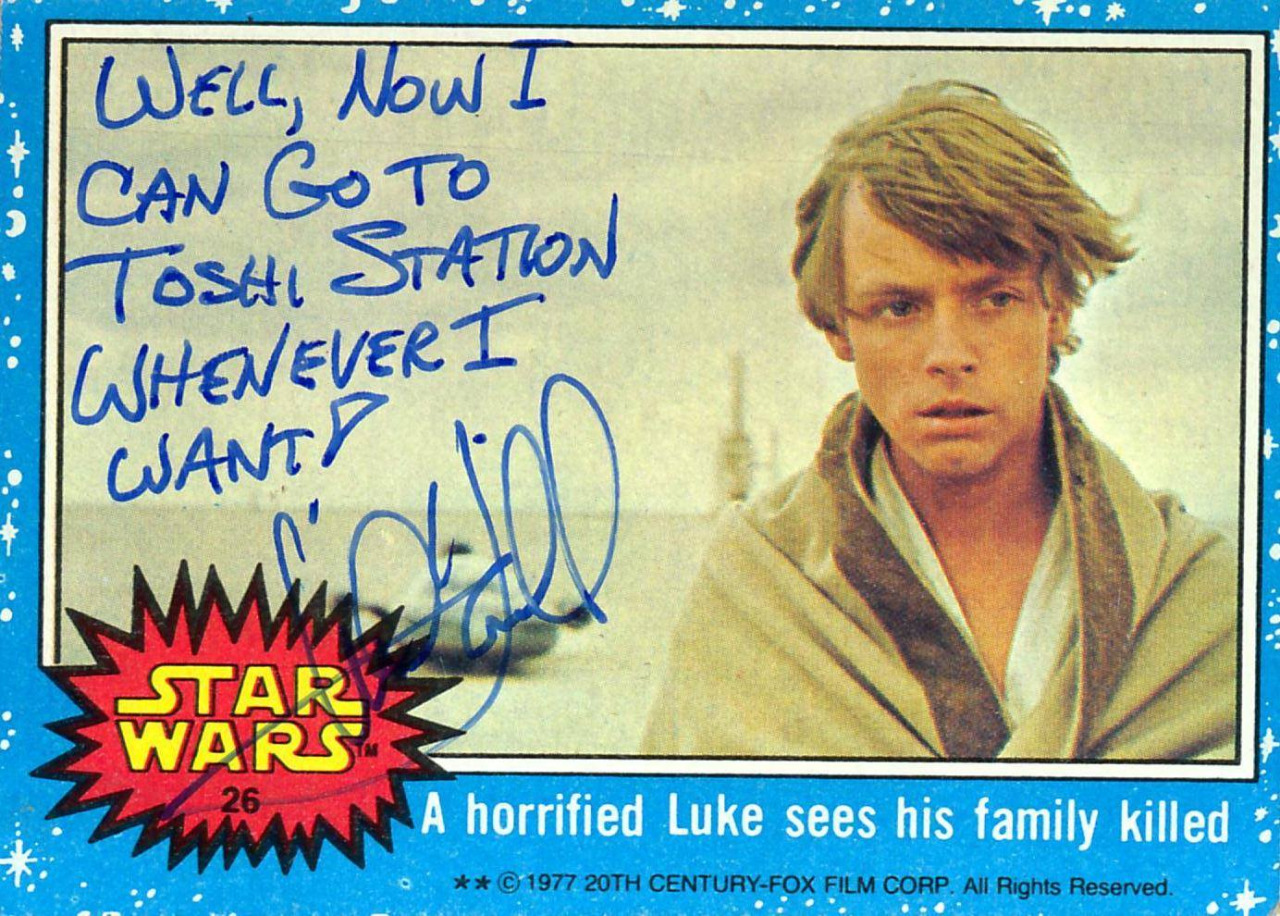
"Keep this in your wallet if you are a pansy fan-boy."

Recent discovery: Mark Hamill autographs. They are the best. He is the best. I love these so much.


Additional discovery: There is an entire Twitter account dedicated to Mark Hamill autographs. Because Mark Hamill autographs are the best.

Tuesday, July 12, 2016

Don't be a snob.

I downloaded Pokemon Go this weekend. Jacob and I spent part of our 6-year-anniversary wandering around a park in Sugarhouse, catching pokemon and collecting poke balls and incubating eggs and trading duplicate Pokemon to Professor Willow for candy. I was never into Pokemon as a kid, so this hasn't been the same "childhood dream come true" for me that it has been for some people. But it's still been awesome.

But I've seen some folks on the internet who feel it's their duty to spread things like this:


Or who keep perpetuating blatantly false stories about how Pokemon Go caused a major traffic accident. Or who take to Twitter to announce their disdain for the game.
SaveSave

To which I say:

You guys.YOU DON'T HAVE TO BE INTO POKEMON GO. But that doesn't make you superior to other people. It doesn't mean you're better than other people. It means you're DIFFERENT from other people. It means you have different tastes and interests. OTHER PEOPLE PLAYING POKEMON GO DOESN'T MAKE YOUR LIFE WORSE.

In fact, the phenomenon is making life better for a lot of people. It's helping people overcome social anxiety and depression. It's allowing people to connect with one another. It's helping people explore their worlds. It's creating bonding opportunities for friends and family members. In a huge way, it's reminding people that we're all part of this big, huge, human family. I can go to a public park, and complete strangers can call out, "Are you a Pokemon trainer?" and we can all sit in the grass together doing this silly thing that connects us as people.

And if ever we needed something that connected us, it's now. It's been a rough year or so. (Decade?) Trump continues to gain popularity despite the fact that he has repeatedly done and said things that are blatantly racist, misogynistic, xenophobic, and anti-Semitic. ISIS continues to destroy lives and monuments. Black men continue to be killed by police officers. Our LGBTQ brothers and sisters are still not safe. So if there's something as harmless as a game that effectively brings huge amounts of people together, despite race, class, gender, political party, religion, or sexual orientation? Let's grab that and run with it.

Or at the very least, let other people grab it and run with it, even if you're not interested.

Wednesday, June 10, 2015

Wandering Wombs: A Brief "Hystery" of Women's Medicine

WARNING: Depending on where you work, this may be NSFW. If you are uncomfortable reading about the history of female sexuality, skip this one. Even though it's enlightening and a little bit hilarious.

So I've been doing a lot of research on "hysteria" lately. And let me tell you, people were completely insane and woefully uninformed when it came to women's health. For like, MOST of human history.

Nowadays, we use the term "hysterical" to mean "crazy" or "experiencing large emotions." But until about 50 years ago, it was considered an actual medical condition exclusive to women.

And it goes all the way back to ancient Greece. Hippocrates (as in "the Hippocratic oath," yeah--that guy) believed that hysteria was caused by a wandering womb. (Hysteria comes from the word hystera, which means "uterus.") See, the basic idea was that lacking the warmth and lubrication of either pregnancy or "the male member," the uterus was prone to wander around the body, blocking important passages and causing disease and general mayhem. As Jacob pointed out, Hippocrates basically said, "I need to create a problem that my penis will solve." (If that ain't patriarchy, I don't know what is.)

By the 1800s, female hysteria was considered an epidemic, with an estimated 1 in 4 women suffering from it. Its symptoms included irritability, sexual desire, faintness, nervousness, shortness of breath, changes in appetite, and "a tendency to cause trouble," among other things.

But don't worry--doctors could get that pesky wandering uterus back into its proper place! Surgery and water hosing were used in drastic cases, but most women could find relief in a "pelvic massage," administered by a doctor.

Let's just call it what it is. (And I apologize if this is crude...) Women throughout the 1800s were going to their doctors on the regular for a hand job.

But take note! Sexual pleasure had nothing to do with it! No, doctors all knew that women experienced no sexual pleasure or desire--they simply submitted to their husbands in the name of duty and procreation. There was no such thing as a "female orgasm." Treatments for hysteria resulted in a "hysterical paroxysm," which was a release of tension caused by that wandering womb.

Jacob pointed out that it's strange that so many women were seeing doctors for the "treatment"--wouldn't it be simpler to just...take matters into their own hands?* Probably. But women were also taught that they didn't experience sexual desire or pleasure, so when they felt it, it was probably incredibly shameful. Masturbation was considered "self-abuse," with a host of dangers associated with it. I think many women really did believe in the medicine of the time--what else was there to believe? It's much safer and more acceptable to visit a doctor for the treatment of a medical condition.

Here's the rub, though.** By the late 1800s, doctors' hands were getting tired. Fatigue and cramps kept them from giving successful treatments. And so, in 1880, Dr Mortimer Granville patented the electromechanical vibrator.


That's right. The vibrator was invented because Victorian doctors were getting cramps from giving hand jobs to middle and upper class women.

"Personal massagers" became a huge hit, and they were sold everywhere from the corner market to the Sears & Roebuck catalogue. Regardless of what was actually going on, they were considered medical instruments, and there didn't seem to be any kind of shame or furtiveness attached to them. It seems bizarre now, but ads like these seemed pretty common:


At least, ads like this were common until the 1920s. Because what started appearing in the 1920s? Pornographic films. The use of "personal massagers" in film stripped them forever of their medical use, and from that point on, there was no escaping the sexual connotation. Vibrators disappeared from the mainstream advertising world until the sexual revolution of the 1970s. Nowadays, you don't often see ads for vibrators in mainstream magazines, but if you're interested in buying one, they aren't very hard to find.

And the disease "hysteria" was finally, FINALLY removed from the diagnostic world officially in 1980, with the publication of the DSM-III.

Please note that 1980 was only 5 years before I was born.

I mean, doctors had figured out long before this that the "wandering womb" theory was bunk and that women did experience sexual pleasure/desire. Throughout the early 1900s, "hysteria" came to also include what we now know as PTSD and mood disorders, which affected both men and women.

But here's what I want to point out. Here's why all of this matters. Aside from giving you an interesting thing to share at parties, I actually have something meaningful to say with this post.

I think that women today are still feeling the effects of thousands of years of being diagnosed instead of listened to. Women's legitimate emotional experiences are still being dismissed as the result of "hormones."


For so many generations, women were seen as emotional creatures incapable of making meaningful decisions. They were seen as needing either pregnancy, intercourse, or medical attention to keep their wombs in their proper place. In times throughout history when women were treated as property under the law, not given a voice in government, and subjugated to lives of domesticity, they responded with "irritability, nervousness, and the tendency to cause trouble." And when they responded this way, they were told that they had a medical condition.

I'm so grateful to live in a time and place where I have so much. I'm so grateful for the men and women who fought so that I could live the immensely privileged life I lead. But the work is not complete. We still have over 2000 years worth of bogus medicine to overcome. Somewhere buried in our collective unconscious is this persistent idea that women can be dismissed because they are emotional, because they are slaves to the hormones in their bodies.

The reality is that both men and women are emotional creatures who are capable of making meaningful decisions anyway. And it's time to acknowledge that.


*pun intented
**pun also intended

Monday, June 23, 2014

Netflix University


I haven't updated this list for months and months, so I've got a LOT of recommendations/reviews for you! Happy learning!


Titanic's Final Mystery
Netflix
I've already watched and recommended Titanic's Achilles Heel, which focuses on how exactly the Titanic sunk (which was NOT how Kate Winslet and Leo DiCaprio would have you believe). But this documentary focuses on why the heck Titanic's lookouts could have FAILED to notice a gigantic iceberg until they were 30 seconds away from it. It also debunks some of the myths surrounding the Titanic--whether or not the captain was drunk, whether or not a nearby ship even knew what was going on. The sinking of the Titanic really was a freak accident, in so many ways. So many elements came together to create a disaster.

Pope Joan
Netflix
Not quite long enough to go as in depth as I would have liked, but a nice little intro to the story. (Granted., there's not a whole lot to the story--resources are limited.) Legend has it that a woman made her way to the papacy in the Middle Ages, and wasn't found out until she collapsed during a procession. BECAUSE SHE WAS GIVING BIRTH.

Beyond Survival With Les Stroud (series)
Netflix
This was one of those things that I enjoyed at the time, but it ended up having a much more profound effect on me as time went on. When you live in the first world, it gets easy to complain, or to have high standards for your living conditions. It sounds cheesy, but you take your four walls and roof for granted, especially if it's not painted perfectly, or is old, or isn't decorated well. But you freaking have WALLS. And there are THOUSANDS of people, around the world RIGHT NOW, who don't have that. And while this means danger and pain for some, there are lots that are just fine. That are okay. For whom that's normal. They are still able to make their lives good. That was a good lesson for me. When I want a new...well, ANYTHING, thinking of my life in comparison to others around the world helps me remember that what I have is JUST FINE.

Escape to Chimp Eden (series)
Netflix
I actually didn't finish this series, and I watch it, oh...two years ago? But I've never posted about it. It's painful at times, but important, and also enjoyable at other times. I got sucked into the drama of it all. It's about a man who runs a chimp sanctuary. Most of the chimpanzees he works with have been taken out of really abusive situations--the entertainment industry, where they were forced to drink/smoke, or from private homes, where people got an exotic pet that they eventually couldn't handle. The most striking thing from this television series that I learned is that chimpanzees can develop the same psychological and physiological disorders that people can--from OCD to alcoholism to schizophrenia to PTSD. That knowledge has deepened my feelings that for the most part, people should let nature be.

Into the Pride (series)
Netflix
Pretty interesting series. A wildlife reserve in Namibia gets a pride of 16 lions, but the lions are so aggressive that they'll either have to be "rehabilitated" or put down. Big cat trainer Dave Salmoni spends six months trying to help the pride balance their natural "wild side" with being calm enough to deal with inevitable human interaction. It was a fascinating look at lion "culture" (as in, the rules and norms of life as a lion), and of all of the issues facing wildlife in Africa right now. And the series has everything you could wish for in a wildlife documentary: thrilling suspense, cute baby animals, family dynamics, etc.

Nazi Temple of Doom
Netflix
This is a "laundry documentary." My friend Carrie has what she calls "laundry movies"...something interesting enough to occupy you, but not so fascinating that you have to give it your full attention. It's a "multi-tasking movie," or something that you could fold laundry to. There was a decent bit of Nazi occult history...man, German politics got WEIRD during that whole WWII era. An interesting, short watch to put on while you're cleaning the house or making dinner or doing a craft or something.

The Elephant in the Living Room
Netflix
I've been really interested lately in the world of exotic pet ownership...somehow, it's just come up fairly often in the last few months, whether on Netflix or National Geographic. It's a bizarrely unregulated world--there are no national laws about exotic pet ownership, and laws vary from state to state. 9 states don't require any kind of permit, and 2 states have no laws at all. It's estimated that there are as many as 20 million exotic pets in the United States--there are more Bengal tigers living in Texas than there are in the wild in India. This documentary follows several exotic pet owners, and does some investigation into the world of the exotic pet trade. There are times when it's emotionally difficult to watch. There was one scene towards the end with a man who owned lions that tore me up for days afterwards. If you are an animal lover, this will probably be a difficult documentary to watch. But it feels like an important one.

One Lucky Elephant
Netflix
Another one with a theme of wild pet ownership, this documentary follows the story of an elephant raised in a circus, and her owner's decision to find her a new home. He'd known her for so long, having raised her since babyhood, and that makes parting ways a difficult and complicated choice. There's also an uncomfortable reality that animals, especially elephants, are much more emotionally developed creatures than we've given them credit for in the past--rehabilitating an elephant who's grown up in the circus reveals some illuminating truths about what captivity does to undomesticated species. 

Fame High
Netflix
A pretty interesting look at the whole "I'm a teenager and I'm going to be famous" world, and the "show-parents"/supportive parents that raise them. That's a pretty generalized summary, but to be honest, I don't think about this documentary very often. I watched it months ago, and found it enlightening at the time, but it didn't quite grab me the way other documentaries do. Perhaps consider it a "laundry documentary."

Surviving Katrina
Netflix
In August of 2005, I was living with dear friends, working a fun job at Walmart, and getting ready for another semester of school to begin. I remember that the night Hurricane Katrina hit, Annie and I were over at Tim and Rosa's house, and Rosa was dying my hair. We had the television on, and the news kept giving updates, but we weren't really paying too much attention. This was one of those things that somehow didn't seem part of my world at the time...I was a little too young and selfish to connect with what happened. But I'm guilty of the same thing so many were--abandoning those I didn't feel connected to. There were so many factors that made this disaster so bad. There was a lack of infrastructure to deal with floodwaters that high, there wasn't enough communication, there were no supplies being sent in, and people were not getting the help they needed. There was one awful story about a doctor who kept requesting ambulances and medical assistance. And for almost a week, nothing came. Finally, he discovered that there was a line of ambulances waiting miles away, and they had been waiting for three days, and when he asked them what they were doing, they replied "We're waiting for patients." No one understood how bad things were, and what was needed. And towards the end, it was so hopeless that the streets became dangerous not because of floodwaters, but because of gunshots. I heard some horrible ideas during Hurricane Katrina, about New Orleans being a "sinful city" that "deserved destruction." I've heard people say that the descent into lawlessness that happened is proof of the depravity of the city. But I would say that what the history of Katrina illustrates far more clearly is that human beings will become how you treat them. If you abandon and dismiss an entire city's people, you cannot expect them to react submissively and calmly. Human beings are far more spirited, and I think their anger and upset was justified. It still is.

Sound City
Amazon Prime
Jacob and I want to be friends with Dave Grohl. So bad. And we love rock music. This is such an inspiring documentary--I hardly ever write music nowadays, but I picked up the guitar before I had even finished watching. I just had this incredible urge to CREATE. The story of the documentary is...well, here's the official blurb: "the film was conceived by Grohl after purchasing the legendary custom-built Neve 8028 recording console from Sound City Studios last year. The board, built in 1972, is considered by many to be the crown jewel of analog recording equipment, having recorded such artists as Neil Young, Fleetwood Mac, Tom Petty, Johnny Cash, Guns and Roses, Metallica, NIN, Rage Against The Machine and countless other musical legends over the past 40 years." It started as the story of the sound board, but became much bigger. So awesome.

Chasing Beauty
Netflix
An honest and interesting look at the labyrinth of the modeling industry. Contrary to popular belief, modeling is much MUCH more than being "pretty"...you have to look INTERESTING. And furthermore, you have to be able to open up on camera and be photogenic. And be personable and friendly. I have a few friends who model professionally, and it's a lot of work. Fun work, but WORK. This documentary follows several people at different stages of modeling careers, and does interviews with industry professionals.

The Antics Roadshow
Netflix
All right, warning. This documentary is made by British graffiti artist Banksy, and as such, it's somewhat rude and rather irreverent. It will very likely offend you if you consider yourself a more conservative type. But if you're willing to look past all that, it's a fun summary of the people who have made shocking artistic projects, streaked publicly, snuck into Buckingham Palace, and generally created chaos and counterculture. Which is fun.

The Pixar Story
Netflix
When you learn the history of Pixar, it's really a miracle that any of it got off the ground at all. But their success has come from the fact that every single person who works there LOVES what they're doing. They care about stories, they're honest with each other, and they work their BUTTS off. John Lasseter spent his entire life wanting to work as an animator, and his passion for the art form is what drove him to create such amazing stories. There's some awesome footage and awesome interviews, and it's all incredibly inspiring to any creative person ever.

The Woman Who Wasn't There
Netflix
This one kept popping up on my "recommended" list on Netflix, and I finally watched it. It's about a woman who basically conned the world into believing that she was in the World Trade Center during the 9/11 attacks. And she wasn't. It's a powerful story of deceit, and how and why people do these things, and how it affects those around them.

Becoming Chaz
Netflix
This is a great and very personal look into the transgender experience. I've been trying to learn more about the transgender community during the last few years, and learning about Chaz Bono's transition from female to male helped me gain a lot of perspective. His transition was so public, and happened at a time when the entire concept of being transgender was still so incredibly understood...I'm really glad he chose to share his story. I think the world has a looooong way to go before gender dysphoria and transgenderism is seen with complete understanding, but stories like this help bring that day a little bit closer.

(A)Sexual
Netflix
It seems like a lot of people are dismissive of asexuality--there's this attitude that it "doesn't exist." It's true that it's not a very common sexual orientation, partly because sexuality traits seem to be genetic, and asexual people tend to not reproduce as often. But it's a completely legitimate sexual orientation, and this documentary does a great job of shedding some light on it, highlighting a handful of individuals who experience it.

Dark Girls
Netflix
This fascinating documentary goes beyond the concepts of "racism" to discuss "colorism"--attitudes about people based on their relative darkness or lightness. Colorism exists within the black community and outside of it. One of the most powerful ideas in the documentary is a point that an educator made. She pointed out that slavery existed in the United States before the United States even existed...black people were treated as animals in the 1600's. Then there was Emancipation without a plan. Slavery ended in 1863, but there was nothing in place to transition society into a non-slavery world. Freed slaves suddenly found themselves facing the same prejudice they had as slaves, except now they had to navigate housing, food, and work on their own as well. The Civil Rights Act was so recent that anyone over the age of 50 today lived during a time when black people had no rights or protections under the law. So in over 400 years of North American history, black people have only been given the right to VOTE, have only been treated legally as PEOPLE for 50 years. And you don't overcome 350 years of psychological damage, of racial "training," in one generation.

Unhung Hero
Netflix
When Patrick Moote's girlfriend rejected his very public proposal, one of the reasons she gave for not wanting to marry him was that his penis was too small. So Patrick sets out on a journey to answer the question "Does size matter?" He travels the world in search of enlightenment and enlargement, and interviews a lot of people along the way. We as a society often point to the pressure that women feel to meet some sort of ideal body standard, but men have similar pressures, and in our oversexualized society, we should talk about how ridiculous those pressures are. (Warning: You probably already guessed this, but there is some nudity and discussion of sexuality. There is also a point when Patrick attends a pornography expo in search of answers.)

Indie Game
Netflix
So beautiful. It actually made me cry. I'm so inspired by people who do what they love...who pursue their passions, no matter what. The video game industry often gets this false reputation--that video games are time-wasting activities played by only young children, or by the psychologically disturbed and violent, or by 35-year-old losers who live in their mom's basements. But it's so false. Video games have grown into a powerful art form that's often LITERARY and symbolic and meaningful. and that's especially true of games that are independently produced. This documentary celebrates that world, and follows the creation of two games: Super Meat Boy and Fez. It's an emotional journey, and whether you care about video games or not, if you're not inspired by this, you're probably a robot.

The Science of Babies
Netflix
A good "laundry documentary." Babies are fascinating and bizarre creatures, and this is a cool look at some of the understanding we've gained about how their brains work, how and why their bodies develop the way they do, and the evolution behind it all. It's also occasionally super-stressful, because several times throughout the program, they explain some aspect of babyhood, and then say, "But there are times when it can all go WRONG" and then do some case study. Spoiler alert: everyone always ends up okay, but it's stressful to watch.

Saturday, May 18, 2013

Mini-Library

Last night, I happened to glance over at our bookshelf, and it occurred to me that our current selection of books is a fairly good glimpse into our lives right now. We couldn't bring ALL of our books to West Yellowstone, so Jacob grabbed a handful. Here's what we've got on the shelf:

A Yellowstone National Park guidebook
Audition by Micheal Shurtleff
True and False: Heresy and Common Sense for the Actor by David Mamet
No Acting Please by Eric Morris and Joan Hotchkis
Improvise: Scene from the Inside Out by Mick Napier
Pandolfini's Ultimate Guide to Chess
Beginning Chess Play
The Green Book
The Feminine Mystique by Betty Friedan
A book on Hume
18th Century Philosophy
a copy of The Koran
The Origin of Species by Charles Darwin
The Oedipus Cycle
Lamp at Midnight by Barrie Stavis
Tinker, Tailor, Soldier, Spy by John le Carre
1984 by George Orwell
Animal Farm by George Orwell
Cat's Cradle by Kurt Vonnegut, Jr
Ender's Game and Speaker for the Dead by Orson Scott Card
Dubliners by James Joyce
Cannery Row by John Steinbeck
Christopher Hitchins' autobiography, Hitch-22
Joseph Smith: Rough Stone Rolling by Richard Lyman Bushman


We're liberal theatre and English majors who like philosophy, religion, and feminism. And chess.