Sunday, October 9, 2016
The "no's" that hurt
Acting = lots of rejection. We all know this. It’s part of life in the arts, blah blah blah. I’ve gotten to be pretty good at dealing with it, but sometimes there are “no’s” that hurt more than others. In an effort to embrace some sense of catharsis and to be honest about my journey as an actress, I thought I’d share a few “no’s” that hurt.
(Wait. I need to make a disclaimer. I 100% respect the casting choices made by the producers in all of these cases. I don’t share these stories to say “I should have been cast!” or to complain or to talk down these producers or theatres. It’s no director or theatre’s “fault” that I didn’t get the part. I’m just trying to be honest about my experiences as an actress and what I learned from them.)
#1. “Les Miserables” at Hale Center Theatre Orem, 2014
I auditioned for this show shortly after playing Sister in “Damn Yankees” at this same theatre, with this same director. Madame Thenardier is one of my DREAM roles, and I was like, 95% certain I’d make it. So when I didn’t even get a call-back, I was pretty crushed. But here’s the reality—I was still in “BYU-I mode,” where if I didn’t get cast in one show, I was almost CERTAIN to be cast in the next. I’d gotten cast in the FIRST thing I auditioned for in Utah, and so there was nothing in my experience to teach me that my being cast wasn’t guaranteed. So I did a mediocre audition, counting on the director knowing me to get me through. But I didn’t do anything in my audition that showed I could play Madame Thenardier. I didn’t do anything in my audition that showed that I was willing to work hard. I didn’t do anything in my audition to show I cared enough about this to give a stellar audition.
This one hurt because it was a dream role. But it also hurt because it was the first time I had to face the reality of rejection in the arts…like, REALLY face it. It was the first time I realized I couldn’t count on the director knowing me, and that I had to truly bring it to every audition, every time. It hurt to learn those things. (But I’m damn glad I did.)
#2. “Peter and the Starcatcher” at Hale West Valley, 2016
This one hurt only because it came right after “Beau Jest,” and I was so in love with “Beau Jest” that I just didn’t want to stop coming to the theatre. I know that there is no role for me in that show—I don’t think I would have made a good Molly. But a few of my “Beau Jest” family members were cast in the show, and it was a little heart-breaking to watch them get to keep doing this thing I love, while I sat at home at night. I had a similar experience with “Christmas Carol,” right after “Oklahoma”…I just loved doing shows at the theatre so much that I didn’t want to stop.
#3. Netflix Original Movie, 2016
Oh man, this one was tough. I won’t go into the details of which film this was, but I’ll say this. My initial audition was one of the best auditions I have ever done in my life. It feels so boastful to say that I nailed the audition, but…I nailed that audition. I was called back on the spot. For a NETFLIX ORIGINAL MOVIE. It wasn’t a huge role, but it was a decent one. Like, I would have been on set for probably 3-5 days. And I nailed the call-back, too. The call-back was with both the casting director and the film’s director, and after I read, the director just looked at me and said, “That was perfect. I have NO notes. So…tell me more about your experience?” We chatted, and I left feeling really really really good about it. I was one of the last people seen that day, and when I signed out, I discovered that I was the ONLY person called back for that role. I knew nothing was guaranteed, but everything about the experience gave me this sense that I had a really good chance.
Here’s the thing about film/television. Often, they’ll cast everyone ahead of time, maybe have a table read, then start shooting. But sometimes, for smaller roles, you won’t hear until later. That happened to me with “Mosaic.” I auditioned in August, they started shooting, and then I got a call saying, “You’ve been offered the role. Can you be there on Thursday?” So when I heard that the Netflix original I had auditioned for started shooting, I was like, “Okay. So I probably didn’t get it. But maybe!”
I had a friend who was a PA on the show, so he kept posting pictures on Instagram of the shoot, and I kept waiting to see if I got the call. Then another friend posted about how she was called in to be a featured extra on the movie. Then another friend posted about landing this amazing speaking role in the movie. And I just kept waiting, and waiting, and waiting, just on the off-chance that I was still cast somehow. I’ve learned that star power carries a little more weight than talent/being right for the role, so I knew that if they got someone with more credits, with a more well-known face and name, they would get the role. But I didn’t want to be the needy girl texting my friends on the project, saying, “Hey, do you know who they got to play ____?”
And then, finally, my PA friend posted about “wrap day,” the last day of filming. And I hadn’t gotten the call. I didn’t get the part. I looked up who DID get the part on IMDB, and she definitely has way more credits than I do. Which is fair enough. And I’m sure she was awesome. She had a great look for the role, and I’m sure I can learn a few things from watching her (and my other friends) in the movie when it came out.
There will be other chances for me, I know. I just want everything NOW.
#4. “Sister Act” at Hale West Valley, 2016
It’s kind of taken me a while to really realize how this one hurts. Present tense, because it’s opening in a few days.
This partly hurt because this “no” came towards the end of this weird sort of surge of “no’s” that I experienced in June and July this year…it just felt like one after another. So not getting called back for “Sister Act” felt like I was being kicked while I was down.
I really, 100% really do understand why I wasn’t cast. My audition was…not great. My song choice was okay, but in retrospect, maybe not the best. And I didn’t sing it well. (In fact, I bombed the ending—played it off as comedy, but I still bombed it.) I didn’t act it well. And even if I had, there is nothing I could bring to the show that someone else couldn’t bring just as well. And “Cabaret” conflicted with like, the first three weeks of “Sister Act” rehearsal (almost half of the rehearsal process). So even if I did have a really great audition, if there are other people who could bring what I could to the show who could be THERE for the entire rehearsal process, then of COURSE, they should be the ones with their names on the list.
But it still hurt. (Hurts.)
My sister and I grew up with the movie “Sister Act.” It’s a huge part of my childhood. There are some significant differences between the film and the musical, but I still feel the same sense of nostalgia. And the messages of “Sister Act” are so beautiful and important to me…messages about being yourself, about worshipping in your own way, about allowing others to express their faith (or lack thereof) in ways that are meaningful to them. About worrying less about appearances and rules and more about genuine spiritual experiences. And those are messages that are especially needed in the Utah community where I live, and it would have been a beautiful privilege to be a part of sharing it.
And some of my dearest, dearest friends are in the show…people whom I love and admire for their work onstage and their friendship offstage. I’ve been so blessed to make some amazing friends since moving to Utah…it’s one of the greatest blessings of my life, in fact. So I feel a little sad that they all get to tell this story that I love together, and that I can’t be a part of it. And from all the posts I’ve seen on social media, it seems like this show is a really special experience for everyone involved. It seems like it stands out for the cast as a really unified production, and a really fulfilling experience, and one that means a lot to them. I’ve been in shows like that…where everyone just sort of feels that this cast is special, and this show is different from the others they’ve done. And I wish with my whole heart I could be a part of this one.
I don’t begrudge my friends the experience. (Friends in “Sister Act,” if you’re reading this, PLEASE don’t feel weird or bad or anything! Don’t stop posting, don’t stop loving your experience, please continue to embrace it for all that it is. Embrace it MORE for what it is.) My feelings aren’t jealousy—I don’t want to take away something you have and have it for myself. I just wish I could share it with you. I’m excited to come watch your work, regardless, though.
The positive thing is that each of these “no’s” also led to other “yes’s.” Whether that means being involved in other projects, or having the chance to take a class, or to focus on writing or school or my family. And each of these “no’s” did teach me something about being an actress, whether it’s to bring your A game to every single moment of every single audition, or that sometimes, you’re just not right for a part, A game or not. To the people who didn’t cast me in the past, or won’t cast me in the future, either way, I have an opportunity to learn and grow, and I respect your choices. I’ll keep learning. I’ll keep working. I’ll keep auditioning. And I’ll probably keep hurting every now and then. But it’s totally worth it. You’ve got to get through the “no’s” to get to the “yes’s.” And I’ll keep doing that. I don’t know how to not keep doing that.
Post-script: It felt really good to write all of this out. I've been catharsisized, and I feel better about life in general already.
photos via this guy and this guy
Monday, October 3, 2016
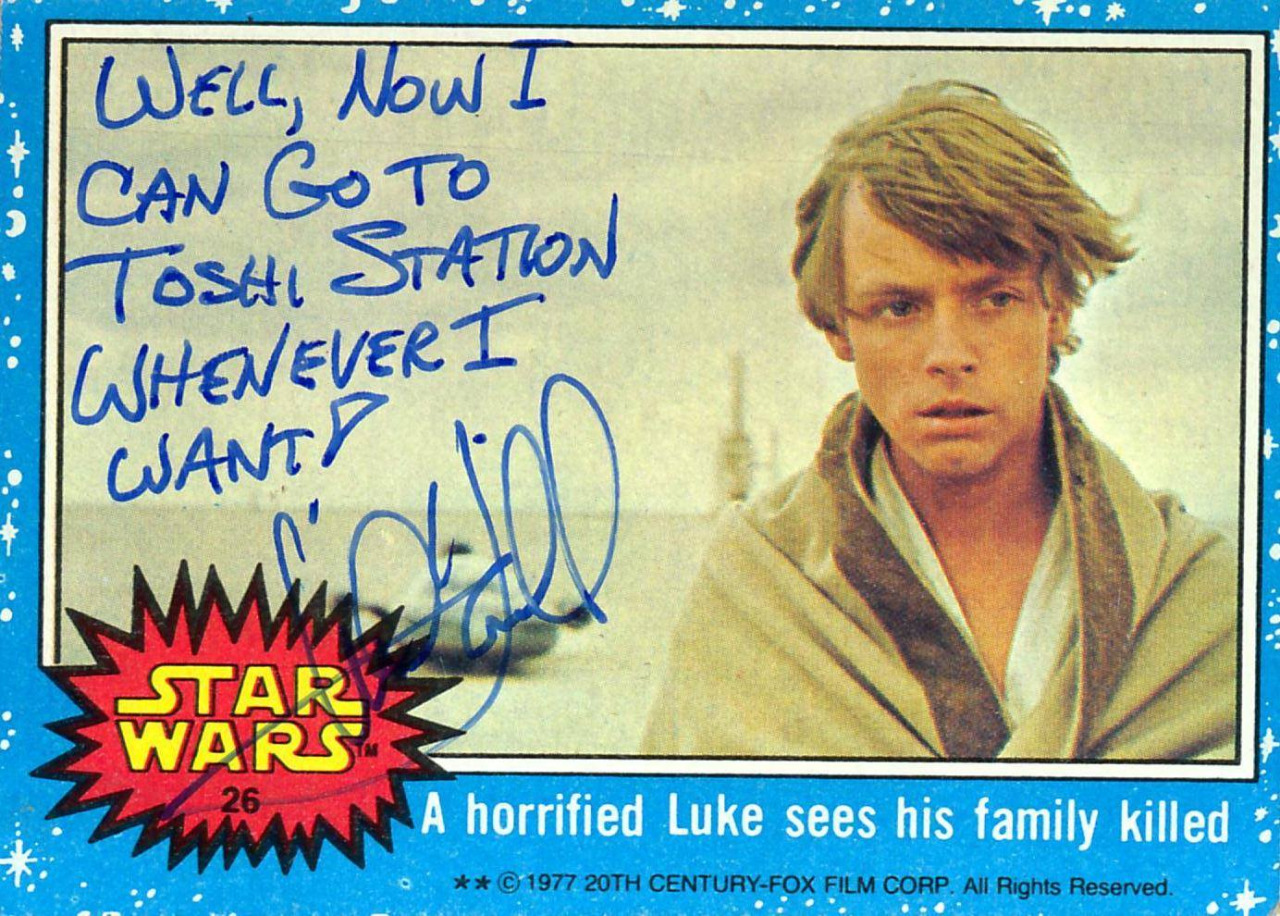
"Keep this in your wallet if you are a pansy fan-boy."
Recent discovery: Mark Hamill autographs. They are the best. He is the best. I love these so much.
Additional discovery: There is an entire Twitter account dedicated to Mark Hamill autographs. Because Mark Hamill autographs are the best.
Friday, September 30, 2016
A Letter to the Upcoming Generation, inspired by a recently completed MFA class called "The Rock Star Poets and Writers"
Dear teenagers of 2016:
If I were truly an authentic, this letter would be handwritten, in a red spiral notebook, Kurt Cobain style. I’d write it in crayon, like Jack White did his receipts when he worked cutting fabric and stapling around the corners of sofas. Or on hotel stationary like I was Bob Dylan and it was 1961 and I was playing shows in Greenwich Village.
But I'm lazy and this is a blog, so typed it is.
In true “Chicken Soup for the Teenage Soul” style, here’s my advice for you upcoming poets and rock stars.
1. Find inspiration everywhere.
Read Shakespeare, and Rimbaud, and Dylan Thomas, and Jack Kerouac. Listen to Iron Maiden, and Pete Seeger, and David Bowie, and Prince. Let all of their words and melodies tumble around inside of you. Let yourself re-tell their stories. Try on their style. Write a poem in the cosmic style of Walt Whitman. Try writing a beat poem and perform it like Allen Ginsberg. Turn on Nirvana, and scribble your thoughts as it plays in the background. It’s like visiting a thrift store…everything has already been used, but you can try things on for size, make alterations, create new combinations. Some things will fit you better than others. But you might discover that something unexpected looks amazing on you. Something that, on the hanger, doesn’t seem to be your “thing.” But it could be that you ROCK those billowy sleeves. Just try things on. Impersonate those who have come before you. You’ll find your own style eventually.
Pete Seeger wrote a song based on verses from Ecclesiastes. Simon and Garfunkel wrote a song based on the poem “Richard Cory” by Edward Arlington Robinson. But you could take more indirect inspiration as well. Lana Del Rey drew inspiration from Walt Whitman’s “I Sing the Body Electric,” and wrote a song playing with some similar themes and images. Paul Westerberg’s song “Crackle and Drag” is inspired by Sylvia Plath’s poem “Edge.” You could “translate” a poem by just adding music, or draw your inspiration from one or two lines.
2. Your poetic voice can support the status quo, question it, or be a part of the human machine that destroys it.
Your words can be Woody Guthrie’s guitar…the “machine that kills fascists.” Don’t feel like you have to stifle your rage. Write about black lives in America. Write about college rape culture. Write about abortion, and Wall Street corruption, and redlining, and the public school system, and the shitty way the United States treats Native Americans. Poetry is not limited to noiseless patient spiders and suicide. Let your anger flow from your spine into your pen. Scratch deep into the paper. Shout about the way things are until they change.
Sisters of Mercy wrote “Dominion/Mother Russia” about the Cold War. Siouxie Soux adapted Abel Meeropol’s “Strange Fruit,” a harsh look at the treatment of black Americans in the South. Plenty of these artists also wrote about love and breakups and the usual pop topics. And that’s fine. But you don’t have to limit yourself to those topics.
3. Don’t let stereotypes destroy your creativity.
You don’t have to be Hemingway, piling up empty bottles. You don’t have to open your heart or legs to violent passion like Rimbaud. You don’t have to make a permanent stop in the woods on a snowy evening like Cobain or Plath or Sexton. Beware the harsh light of fame. Despite the viciousness of the artistic life, fame is far more destructive. You set the terms. Guard the terms of your fame fiercely.
I think Kurt Cobain both wanted and didn’t want fame. I think he wanted to be known and loved, but didn’t want to be the symbol of his generation. (Same with Bob Dylan.) It can be easy to get caught up in those tensions, but you don’t have to. Just follow your voice, even if it leads you away from the spotlight. Your work is more important than your fame.
4. On a practical note, be intentional about stanza length in your work.
Many poets insert line breaks where they “feel” them in the content, where there’s a natural pause. (And by “many poets,” I mean me, specifically. I’ve been writing poetry consistently since 1998, and this is the first time I’ve considered that even in free form poetry, line breaks make a difference.) This has an effect both visually and rhythmically, one that you may not intend. There is something powerful in being consistent in stanza length. At the very least, be intentional. If there is no pattern to stanza length, make sure you have a good reason for it. Is the work supposed to be disjointed and chaotic? Or tidy and clean? Don’t let line breaks distract from the message and meaning of your poem. Stanza length is another tool in your poetry writing kit…it’s like clothing. You’re saying something about yourself, whether you intend to or not. If you ignore your clothing, you’re sending the message that you don’t care. Same with stanza length.
5. Cut the extraneous stuff.
Listen. I know. These are darlings and it’s hard to kill them. This is the lesson that I have to relearn over and over and over again. Maybe you’re used to prose poetry, or maybe you just make pets of pretty, docile words. As an exercise, try this: Write a poem, then let it sit for 24 – 48 hours. Don’t even look at it. Don’t re-read it, don’t leave it out where it can be glanced at. Then go back and cut it by a third. Ask yourself: “If an editor demanded a word count limit that’s less than what I have, what would I keep?” Trim until the poem is tidy. Condense meaning until it’s compact and hard and dense. Say what you need to, and then get out of there.
Monday, September 19, 2016
Things To Do While 31
Hey, I had a birthday recently! And I've been doing a lot of thinking about my birthday goals. I think I want to continue this tradition, but I think I'm going to do 3 goals per year. The purpose of having these yearly goals is to help me move towards my mountains, and to do things I've always (or just lately) wanted to do and probably won't do unless it's on a list somewhere. But I don't want these things to DISTRACT me from other important progress. So we'll limit the list to 3 goals.
And I like doing things on my birthday instead of New Year's--New Year's doesn't feel like a natural time to make goals. It's in the dead of winter, in the middle of this time of hibernation. I like making my goals in September, as summer is ending, and I start to prepare the house for colder weather and come up with projects to motivate me when the days are shorter. Plus, I'm a rebel/hipster and I don't want to do New Year's Goals because EVERYONE does New Year's goals.
So here are my Things To Do While 31!
1. Read 1 script per month
I want to write more scripts, and I'm a big believer that you should read the types of things you want to write. And I know there are thousands (TENS OF THOUSANDS) of amazing scripts out there that I just haven't gotten to yet. I want to have read 12 new scripts by the time I'm 32. They can be TV episodes, screenplays, plays, etc.
2. Write a spec script
I have zero intention of publishing or sending out said spec script. I consider it purely an exercise in writing. It's a good way to start--it's kind of like fan fiction. The characters, world, and format already exist...I'm just creating a different story. I'm bowling with the gutter bumpers up, so to speak. I'm thinking "The X-Files"? I'll keep you posted.
3. Complete 1 painting
I've had this on my list before, and I've had a few different ideas for paintings floating around in my head lately. I think I'd like to make one of them a reality this year.
And I like doing things on my birthday instead of New Year's--New Year's doesn't feel like a natural time to make goals. It's in the dead of winter, in the middle of this time of hibernation. I like making my goals in September, as summer is ending, and I start to prepare the house for colder weather and come up with projects to motivate me when the days are shorter. Plus, I'm a rebel/hipster and I don't want to do New Year's Goals because EVERYONE does New Year's goals.
So here are my Things To Do While 31!
1. Read 1 script per month
I want to write more scripts, and I'm a big believer that you should read the types of things you want to write. And I know there are thousands (TENS OF THOUSANDS) of amazing scripts out there that I just haven't gotten to yet. I want to have read 12 new scripts by the time I'm 32. They can be TV episodes, screenplays, plays, etc.
2. Write a spec script
I have zero intention of publishing or sending out said spec script. I consider it purely an exercise in writing. It's a good way to start--it's kind of like fan fiction. The characters, world, and format already exist...I'm just creating a different story. I'm bowling with the gutter bumpers up, so to speak. I'm thinking "The X-Files"? I'll keep you posted.
3. Complete 1 painting
I've had this on my list before, and I've had a few different ideas for paintings floating around in my head lately. I think I'd like to make one of them a reality this year.
Saturday, August 20, 2016
I'm Tired of Marvin Asking Me What's Going On
My grandparents recently sent me an email (WITH AN EMOJI!!!) telling me they've been hoping for a blog update soon. It was the final motivation I needed to dash one off really quickly. Things have been busy in the House of Chapman. Here's what's going on.
Getting a job!
I work 20 hours a week as a receptionist for a graphic design company called Royter Snow! I applied on Monday morning, interviewed Tuesday morning, and started work on Wednesday morning. It's really fun! My organizational heart is happy with the tasks I do, and I have plenty of down-time where I'm allowed to work on homework. The guys who run the business are friendly and laid-back, and the building is awesome. (When I mentioned my acting work during my interview, the business owners said I'm welcome to take off for an interview or day of filming if that ever comes up. PERFECT JOB.)
(Incidentally, if you're looking for an office space in Salt Lake City, Royter Snow has two suites available for rent. Only $420 per month. Check out the KSL ad here.)
And working with designers means my office space is pretty. Here is a picture of the view from the break room.
Cabaret!
OMG WE OPEN ON FRIDAY. I feel super good about the show, and a little nervous about layering ALL the tech in over just four days. But it's happening whether I'm nervous or not. We did a "sitzprobe" with our small orchestra today and I grinned my way through most of "Wilkommen." It sounds SO GOOD. So full and lively and gritty and awesome! If you'd like to see me in vintage tap pants, you can get tickets here. Aaaaaand you'll get two for one*--Jacob is also in it! Surprise! A cast member had to drop out, and the production team was desperate to find someone to replace him, and I put Jacob's name/face forward, and now he's Ernst Ludwig. And he's spectacular. Obviously. Everyone is. Here is a picture of Anne-Louise Brings, who plays Sally Bowles, in rehearsal with the orchestra at a local studio.
Liz gets an MFA!
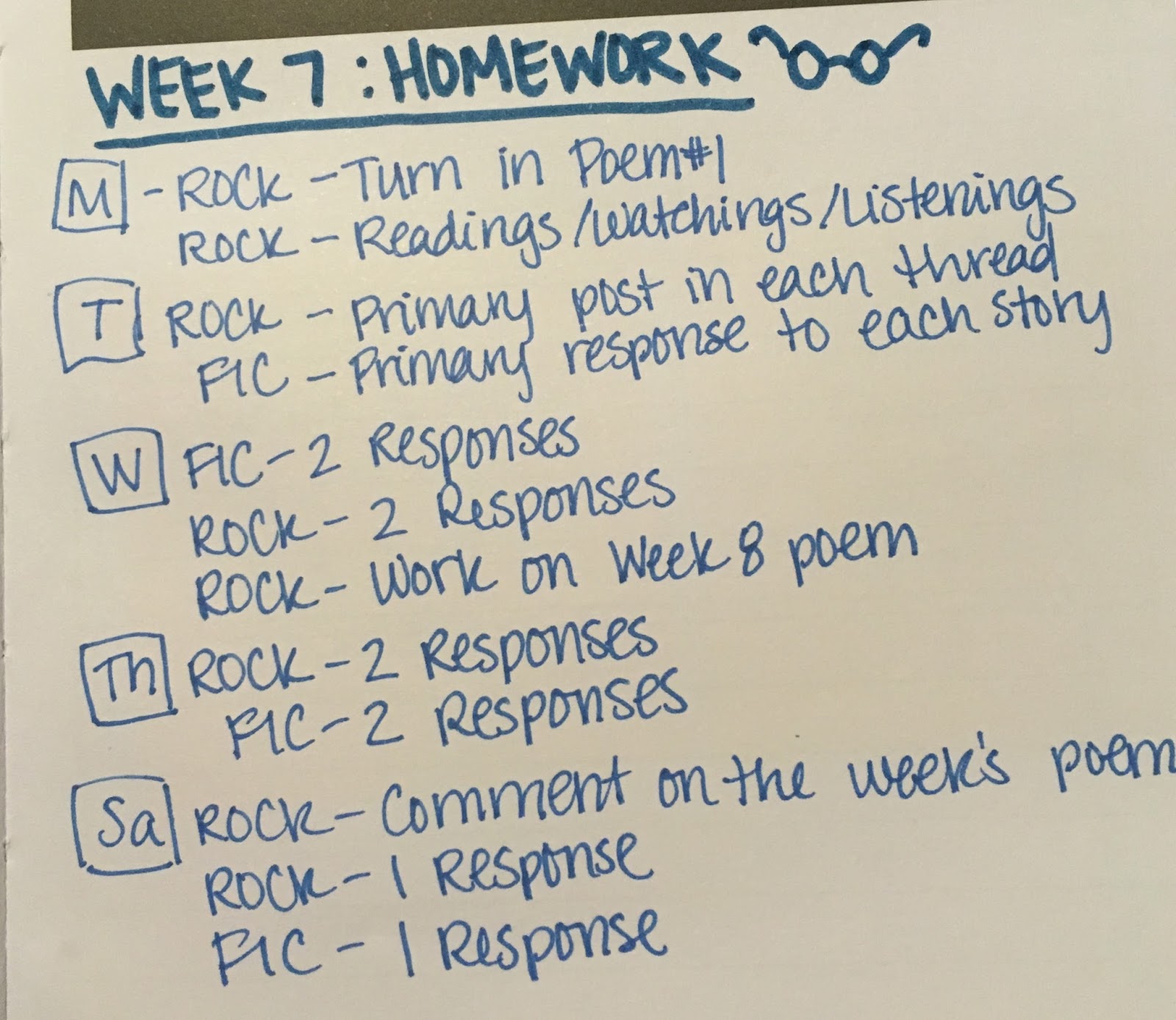
Still plugging away at my Masters. There are days when I feel so certain that it's the right thing to do, and other days when I question my decision. But deep down, I know that this degree will open doors for me that were previously closed, both because of the degree itself, and because of the writing skills I'm learning. This semester I'm taking two classes: The Craft of Fiction, and "The Rock Stars and the Poets." The last class is as fun and interesting as it sounds. Here is a picture of my homework for this week.
Acting!
I've had a bit of a dry spell when it comes to casting, and for a while there, it was really rough. As much as I intellectually KNOW that rejection is a big part of this industry, it can still get to you. During July, I had 8 auditions and didn't get cast at all. I know that doesn't sound like a lot, but that's twice a week. When you're getting a "no" twice a week, it starts to feel like it must be something personal or something. It threw me into a little funk for a minute, there, and I'm still sort of re-arranging my psyche to help me better deal with rejection in the future. In the meantime, I keep auditioning! The dry spell can't last forever. I do not have a picture to accompany this item on the list.
The Internet!
I love the internet. So to conclude, here is a favorite thing from the internet lately. In response to a prompt to name the creatures on this old-timey map, someone came up with these species names:
D - Pigdoggle
E - Snuffcumberworm
F - Schnozpoddler
G - Seahorse
H - Piggly Frontwave
(Snuffcumberworm and Schnozpoddler are my favorites.)
*Beedle-dee-dee-dee-DEE.
SaveSave
Getting a job!
I work 20 hours a week as a receptionist for a graphic design company called Royter Snow! I applied on Monday morning, interviewed Tuesday morning, and started work on Wednesday morning. It's really fun! My organizational heart is happy with the tasks I do, and I have plenty of down-time where I'm allowed to work on homework. The guys who run the business are friendly and laid-back, and the building is awesome. (When I mentioned my acting work during my interview, the business owners said I'm welcome to take off for an interview or day of filming if that ever comes up. PERFECT JOB.)
(Incidentally, if you're looking for an office space in Salt Lake City, Royter Snow has two suites available for rent. Only $420 per month. Check out the KSL ad here.)
And working with designers means my office space is pretty. Here is a picture of the view from the break room.
Cabaret!
OMG WE OPEN ON FRIDAY. I feel super good about the show, and a little nervous about layering ALL the tech in over just four days. But it's happening whether I'm nervous or not. We did a "sitzprobe" with our small orchestra today and I grinned my way through most of "Wilkommen." It sounds SO GOOD. So full and lively and gritty and awesome! If you'd like to see me in vintage tap pants, you can get tickets here. Aaaaaand you'll get two for one*--Jacob is also in it! Surprise! A cast member had to drop out, and the production team was desperate to find someone to replace him, and I put Jacob's name/face forward, and now he's Ernst Ludwig. And he's spectacular. Obviously. Everyone is. Here is a picture of Anne-Louise Brings, who plays Sally Bowles, in rehearsal with the orchestra at a local studio.
Liz gets an MFA!
Still plugging away at my Masters. There are days when I feel so certain that it's the right thing to do, and other days when I question my decision. But deep down, I know that this degree will open doors for me that were previously closed, both because of the degree itself, and because of the writing skills I'm learning. This semester I'm taking two classes: The Craft of Fiction, and "The Rock Stars and the Poets." The last class is as fun and interesting as it sounds. Here is a picture of my homework for this week.
Acting!
I've had a bit of a dry spell when it comes to casting, and for a while there, it was really rough. As much as I intellectually KNOW that rejection is a big part of this industry, it can still get to you. During July, I had 8 auditions and didn't get cast at all. I know that doesn't sound like a lot, but that's twice a week. When you're getting a "no" twice a week, it starts to feel like it must be something personal or something. It threw me into a little funk for a minute, there, and I'm still sort of re-arranging my psyche to help me better deal with rejection in the future. In the meantime, I keep auditioning! The dry spell can't last forever. I do not have a picture to accompany this item on the list.
The Internet!
I love the internet. So to conclude, here is a favorite thing from the internet lately. In response to a prompt to name the creatures on this old-timey map, someone came up with these species names:
D - Pigdoggle
E - Snuffcumberworm
F - Schnozpoddler
G - Seahorse
H - Piggly Frontwave
(Snuffcumberworm and Schnozpoddler are my favorites.)
*Beedle-dee-dee-dee-DEE.
SaveSave
Tuesday, July 19, 2016
All My Salt Lake City Acting Advice in One Big Post
These were originally published as 3 separate entries. But I've shortened and compiled them here, with updated information.
DISCLAIMER: My info is limited to my own experience. There are plenty of other actors out there who will have different advice and different insights. I am not any kind of resident expert--just sharing what I know. So ask around--lots of other folks ARE resident experts.
1. Get good headshots.
This is so so so important. Like, this is what will get you in the door, and help people remember you. Here's what a headshot should be: It should focus on your face, and specifically on your eyes. Choose colors that flatter your skin and hair color, and stay away from black, white, and busy patterns. You should have two main headshots: one "commercial" (smiling, friendly) and one "theatrical" (serious "acting" headshot). If you plan on modeling or submitting for lots of extra work, you can also spend a little extra and get a few "full-body" shots.
2. Remember that there are LOTS of factors that go into casting.
Talent is a part of it, but it's only one small part. Other factors include look, type, voice, availability, compatibility, how much they'd have to pay you, pure instinct, what phase of the moon it is, the will of reptilian overlords, etc. It's impossible to know why casting decisions are made. And remember that success is a numbers game, as much as anything else. For every "yes," there will be at least ten "no's." So just keep auditioning. Sometimes it's pure statistics...the more you audition, the more likely it is that you'll be cast. Keep getting yourself out there, even if it feels like nothing is happening. (And when nothing is, remember the parable of "F you, Matt Damon.") So just give it the best you've got, and don't get too discouraged when you don't get something.
3. Actually, expect to be discouraged.
Sometimes. Not all the time. But discouragement is almost inevitable. So is poverty. Especially when you start out. I think a lot of people start out by thinking that they won't experience discouragement and poverty like every other actor, but you probably will. That's okay. Join the ranks.
4. Keep an audition diary.
It can be as detailed or as simple as you'd like it to be. This serves a couple of purposes. One, it will help you keep track of who you've auditioned for before, and if you've done any followup. Two, it will give you a chance to record thoughts and/or things you've learned. Finally, it actually offers a bit of encouragement to see what you've gotten, compared to what you haven't gotten.
5. Take a class.
Acting is a muscle, and if you're not working for a little while, taking a class is a great way to help you improve your work. It can also give you "networking" opportunities, and help you build your audition repertoire. Sometimes another pair of eyes can see something about your work that you're not seeing, and can give you additional advice. (I highly recommend Ben Hopkin's class "The Three C's of Acting.")
6. ASK for help, guidance, and advice.
When we first made a plan to move to Utah, I sent messages out to everyone I knew who worked in acting in this area. I asked them every question I could think of, and their advice and guidance made my own career here possible. Sometimes we're afraid to ask for help, because we think it will make us look weak, or we're afraid to bother someone. But the reality is that people often respect those who ask for help, and they're often happy to provide their thoughts. It has always been 100% worth it to reach out to others in the field.
7. Remember that your body is your most important tool.
Treat it well. Learn to eat well, sleep well, exercise well.
8. Don't ever forget your CRAFT.
This is the most most most important thing. This is my deepest belief about acting as a career. In the midst of all of these businesslike tasks--"networking," getting headshots, taking classes, updating your resume, tracking your expenses--don't ever lose sight of your work AS AN ACTOR. Don't get into this for the fame or money. Get into this for the art. Take every opportunity to continue to improve and learn and grow. Challenge yourself. Connect with and listen to your fellow actors, on and offstage/screen. Your work as an actor must be about the human experience. If you don't know why you're doing this, that's okay. But try to find out. Think about and create your own philosophy of acting. Learn about techniques and systems, and find tools that work for you. Continually build your tool-box as an actor. Don't forget why you're doing this. Being good-looking, having a good resume, knowing the right people--none of it matters as much as your CRAFT.
9. Get to know others in the industry
I hate the word "networking." It makes me think of schmoozing people at parties, which is exactly the kind of thing I hate. Don't befriend people because you think they'll be helpful in your career. Think of "networking" as sharing what you love with other people who have the same passions. Think not only about how someone can help you create meaningful art, but how you can help them, and what ways you can create awesome things together.
10. Make decisions about your standards
Are you willing to swear onstage? Portray violence? Sexuality? Are you willing to take off some of your clothes? I'm not here to tell you what to be comfortable with. But be thoughtful about what kinds of stories you want to tell, and what you think needs to be done to tell those stories, and how willing you are to do those things. (For some of my personal thoughts on this, check out this past blog entry about Cabaret.)
1. Get with a good agency.
This is the best way to get great auditions. Most major films and television shows DON'T have open auditions--they just don't have time to weed through everyone. So they'll contact the local agencies and run auditions through them.
BEWARE ANY AGENCY THAT ASKS FOR MONEY UP FRONT. Reputable agencies in this area will take a fee from your paycheck anytime they get you work, but they won't require certain classes or headshot sessions or initiation fees. They may recommend or ask that your headshots are of a certain quality, but a professional agency will not force you to use THEIR photographers. Reputable Utah Agencies: McCarty, Talent Management Group (TMG), Elevate, Stars.
To submit to agencies, keep an eye on their websites and look for an open call. You can also stop by with your headshot and resume, but you’ll probably either need an impressive resume, or a strong recommendation from someone inside the agency.
2. Build your IMDB credits.
This is becoming more and more of an important "resume." It's easily accessible to everyone in the industry (they don't have to know your personal website URL to get info about you). You can put your demo reel and your agency contact info on your page. And you can't fake any credits on IMDB. In order to gain control of your IMDB page, you've got to create an IMDB Pro account, which runs $150 per year, or $20 per month. Your IMDB page will be created automatically if you get cast in something that the film creator puts on IMDB, or you can create your own page and add your own credits. You have to submit your acting credits, and they have to be approved.
NOTE: DON'T LIST BACKGROUND/EXTRA WORK ON YOUR IMDB.
3. Create a demo reel
This can be tough if you haven't done much film. BUT, you can use what you have to your advantage. Don't have anything? Then create your own stuff! Find a few scenes or monologues, and film them. There are a handful of folks in the SLC/Provo area who will help you create a demo reel for a small fee, or you can do it yourself on iMovie or a similar program. Just make it look as professional as possible--this is a casting director's big chance to see your work!
4. Do background work!
This is the very very very very best way to learn about film and television if you’re a complete noob. Don’t do this to be discovered. Do this to learn the ropes. It is EXTREMELY RARE for anyone to be "discovered" by doing extra work. I can almost 100% guarantee that it will not happen. But what will happen is that you’ll get to meet and work with awesome industry professionals, and you’ll learn all the jargon of being on set and how everything works.
You can find out about extras calls here:
G&G Casting
Yun Casting
Utah Actor’s NING
Utah Filmmakers and Actors Facebook group
1. Build your audition repertoire.
Buy a binder and fill it with sheet music of songs you know, and make 16-32 bar cuttings of them. Bring it to auditions, along with copies of your headshot and resume. Have a handful of monologues memorized or handy (30 seconds - 1 minute, both comedic and dramatic.) Practice often. Build variety. Know your strengths and play to them.
2. Get audition coaching.
Starting with my "Oklahoma" audition, I've been going to Audition Advantage in North Salt Lake, and IT'S SO AWESOME. Erin, Jeanne, and Anne are all amazing. They can help you find a song, give you info about the production team and what they'll be looking for, coach you on the acting and singing, help you cut your music, help you pick an outfit, RECORD A REHEARSAL TRACK. I love it. No matter how good you are, it's always helpful to have fresh eyes. When I went there with my audition song for "Oklahoma," I was thinking I don't know what else these ladies can do for me. But Erin helped me break down the song and fill in the gaps, and I don't think I would have been called back without her guidance. It runs about $60/hour, but they'll also pro-rate that if you take less time.
There are lots more companies, but here are the ones that I've worked with, seen shows at, or heard great things about. (If you have strong feelings about the content of plays you're interested in performing in, I'd encourage you to research the shows themselves. Note that generally, Hale Orem and Hale West Valley will always produce "family-friendly shows.")
Instead of taking up a bunch of real estate on this page with lists and links, I created this Google Spreadsheet.
1. How do you format your resume?
Simply. You can see how I've done mine here. Print out a dozen copies, 8x10, and put them in your audition binder, so you don't have to worry about it on your next audition.
2. Should you join Equity (Actor’s Equity Association, Theatre Union) or SAG (Screen Actor’s Guild, film/television union)?
That's up to you. There are pros and cons, and it takes some research, but for most people, the answer is "no." The theatres in Salt Lake are limited in how many Equity contracts they can offer, and if you’re Equity, you HAVE to work under an Equity contract. You don’t have to be a member of SAG to do a SAG project in Utah. Joining a union always includes this dichotomy: You'll get less work, but it will probably be better paid work. I’d say become eligible, so you can put that on your resume and show you’re legit, but wait to actually join.
3. How do you find out about auditions?
Most theaters will post their audition info online. Film and television projects will usually just cast through agencies, but sometimes independent projects will send out casting calls on the Utah Filmmakers and Actor’s Facebook page.
DISCLAIMER: My info is limited to my own experience. There are plenty of other actors out there who will have different advice and different insights. I am not any kind of resident expert--just sharing what I know. So ask around--lots of other folks ARE resident experts.
1. Get good headshots.
This is so so so important. Like, this is what will get you in the door, and help people remember you. Here's what a headshot should be: It should focus on your face, and specifically on your eyes. Choose colors that flatter your skin and hair color, and stay away from black, white, and busy patterns. You should have two main headshots: one "commercial" (smiling, friendly) and one "theatrical" (serious "acting" headshot). If you plan on modeling or submitting for lots of extra work, you can also spend a little extra and get a few "full-body" shots.
2. Remember that there are LOTS of factors that go into casting.
Talent is a part of it, but it's only one small part. Other factors include look, type, voice, availability, compatibility, how much they'd have to pay you, pure instinct, what phase of the moon it is, the will of reptilian overlords, etc. It's impossible to know why casting decisions are made. And remember that success is a numbers game, as much as anything else. For every "yes," there will be at least ten "no's." So just keep auditioning. Sometimes it's pure statistics...the more you audition, the more likely it is that you'll be cast. Keep getting yourself out there, even if it feels like nothing is happening. (And when nothing is, remember the parable of "F you, Matt Damon.") So just give it the best you've got, and don't get too discouraged when you don't get something.
3. Actually, expect to be discouraged.
Sometimes. Not all the time. But discouragement is almost inevitable. So is poverty. Especially when you start out. I think a lot of people start out by thinking that they won't experience discouragement and poverty like every other actor, but you probably will. That's okay. Join the ranks.
4. Keep an audition diary.
It can be as detailed or as simple as you'd like it to be. This serves a couple of purposes. One, it will help you keep track of who you've auditioned for before, and if you've done any followup. Two, it will give you a chance to record thoughts and/or things you've learned. Finally, it actually offers a bit of encouragement to see what you've gotten, compared to what you haven't gotten.
5. Take a class.
Acting is a muscle, and if you're not working for a little while, taking a class is a great way to help you improve your work. It can also give you "networking" opportunities, and help you build your audition repertoire. Sometimes another pair of eyes can see something about your work that you're not seeing, and can give you additional advice. (I highly recommend Ben Hopkin's class "The Three C's of Acting.")
6. ASK for help, guidance, and advice.
When we first made a plan to move to Utah, I sent messages out to everyone I knew who worked in acting in this area. I asked them every question I could think of, and their advice and guidance made my own career here possible. Sometimes we're afraid to ask for help, because we think it will make us look weak, or we're afraid to bother someone. But the reality is that people often respect those who ask for help, and they're often happy to provide their thoughts. It has always been 100% worth it to reach out to others in the field.
7. Remember that your body is your most important tool.
Treat it well. Learn to eat well, sleep well, exercise well.
8. Don't ever forget your CRAFT.
This is the most most most important thing. This is my deepest belief about acting as a career. In the midst of all of these businesslike tasks--"networking," getting headshots, taking classes, updating your resume, tracking your expenses--don't ever lose sight of your work AS AN ACTOR. Don't get into this for the fame or money. Get into this for the art. Take every opportunity to continue to improve and learn and grow. Challenge yourself. Connect with and listen to your fellow actors, on and offstage/screen. Your work as an actor must be about the human experience. If you don't know why you're doing this, that's okay. But try to find out. Think about and create your own philosophy of acting. Learn about techniques and systems, and find tools that work for you. Continually build your tool-box as an actor. Don't forget why you're doing this. Being good-looking, having a good resume, knowing the right people--none of it matters as much as your CRAFT.
9. Get to know others in the industry
I hate the word "networking." It makes me think of schmoozing people at parties, which is exactly the kind of thing I hate. Don't befriend people because you think they'll be helpful in your career. Think of "networking" as sharing what you love with other people who have the same passions. Think not only about how someone can help you create meaningful art, but how you can help them, and what ways you can create awesome things together.
10. Make decisions about your standards
Are you willing to swear onstage? Portray violence? Sexuality? Are you willing to take off some of your clothes? I'm not here to tell you what to be comfortable with. But be thoughtful about what kinds of stories you want to tell, and what you think needs to be done to tell those stories, and how willing you are to do those things. (For some of my personal thoughts on this, check out this past blog entry about Cabaret.)
1. Get with a good agency.
This is the best way to get great auditions. Most major films and television shows DON'T have open auditions--they just don't have time to weed through everyone. So they'll contact the local agencies and run auditions through them.
BEWARE ANY AGENCY THAT ASKS FOR MONEY UP FRONT. Reputable agencies in this area will take a fee from your paycheck anytime they get you work, but they won't require certain classes or headshot sessions or initiation fees. They may recommend or ask that your headshots are of a certain quality, but a professional agency will not force you to use THEIR photographers. Reputable Utah Agencies: McCarty, Talent Management Group (TMG), Elevate, Stars.
To submit to agencies, keep an eye on their websites and look for an open call. You can also stop by with your headshot and resume, but you’ll probably either need an impressive resume, or a strong recommendation from someone inside the agency.
2. Build your IMDB credits.
This is becoming more and more of an important "resume." It's easily accessible to everyone in the industry (they don't have to know your personal website URL to get info about you). You can put your demo reel and your agency contact info on your page. And you can't fake any credits on IMDB. In order to gain control of your IMDB page, you've got to create an IMDB Pro account, which runs $150 per year, or $20 per month. Your IMDB page will be created automatically if you get cast in something that the film creator puts on IMDB, or you can create your own page and add your own credits. You have to submit your acting credits, and they have to be approved.
NOTE: DON'T LIST BACKGROUND/EXTRA WORK ON YOUR IMDB.
3. Create a demo reel
This can be tough if you haven't done much film. BUT, you can use what you have to your advantage. Don't have anything? Then create your own stuff! Find a few scenes or monologues, and film them. There are a handful of folks in the SLC/Provo area who will help you create a demo reel for a small fee, or you can do it yourself on iMovie or a similar program. Just make it look as professional as possible--this is a casting director's big chance to see your work!
4. Do background work!
This is the very very very very best way to learn about film and television if you’re a complete noob. Don’t do this to be discovered. Do this to learn the ropes. It is EXTREMELY RARE for anyone to be "discovered" by doing extra work. I can almost 100% guarantee that it will not happen. But what will happen is that you’ll get to meet and work with awesome industry professionals, and you’ll learn all the jargon of being on set and how everything works.
You can find out about extras calls here:
G&G Casting
Yun Casting
Utah Actor’s NING
Utah Filmmakers and Actors Facebook group
1. Build your audition repertoire.
Buy a binder and fill it with sheet music of songs you know, and make 16-32 bar cuttings of them. Bring it to auditions, along with copies of your headshot and resume. Have a handful of monologues memorized or handy (30 seconds - 1 minute, both comedic and dramatic.) Practice often. Build variety. Know your strengths and play to them.
2. Get audition coaching.
Starting with my "Oklahoma" audition, I've been going to Audition Advantage in North Salt Lake, and IT'S SO AWESOME. Erin, Jeanne, and Anne are all amazing. They can help you find a song, give you info about the production team and what they'll be looking for, coach you on the acting and singing, help you cut your music, help you pick an outfit, RECORD A REHEARSAL TRACK. I love it. No matter how good you are, it's always helpful to have fresh eyes. When I went there with my audition song for "Oklahoma," I was thinking I don't know what else these ladies can do for me. But Erin helped me break down the song and fill in the gaps, and I don't think I would have been called back without her guidance. It runs about $60/hour, but they'll also pro-rate that if you take less time.
There are lots more companies, but here are the ones that I've worked with, seen shows at, or heard great things about. (If you have strong feelings about the content of plays you're interested in performing in, I'd encourage you to research the shows themselves. Note that generally, Hale Orem and Hale West Valley will always produce "family-friendly shows.")
Instead of taking up a bunch of real estate on this page with lists and links, I created this Google Spreadsheet.
1. How do you format your resume?
Simply. You can see how I've done mine here. Print out a dozen copies, 8x10, and put them in your audition binder, so you don't have to worry about it on your next audition.
2. Should you join Equity (Actor’s Equity Association, Theatre Union) or SAG (Screen Actor’s Guild, film/television union)?
That's up to you. There are pros and cons, and it takes some research, but for most people, the answer is "no." The theatres in Salt Lake are limited in how many Equity contracts they can offer, and if you’re Equity, you HAVE to work under an Equity contract. You don’t have to be a member of SAG to do a SAG project in Utah. Joining a union always includes this dichotomy: You'll get less work, but it will probably be better paid work. I’d say become eligible, so you can put that on your resume and show you’re legit, but wait to actually join.
3. How do you find out about auditions?
Most theaters will post their audition info online. Film and television projects will usually just cast through agencies, but sometimes independent projects will send out casting calls on the Utah Filmmakers and Actor’s Facebook page.
Friday, July 15, 2016
Under construction
Sorry if things are a little messy around here for a few days...I'm re-vamping the ole blog, but I don't quite have time to do it all at once. Love you guys.
Tuesday, July 12, 2016
Don't be a snob.
I downloaded Pokemon Go this weekend. Jacob and I spent part of our 6-year-anniversary wandering around a park in Sugarhouse, catching pokemon and collecting poke balls and incubating eggs and trading duplicate Pokemon to Professor Willow for candy. I was never into Pokemon as a kid, so this hasn't been the same "childhood dream come true" for me that it has been for some people. But it's still been awesome.
But I've seen some folks on the internet who feel it's their duty to spread things like this:
Or who keep perpetuating blatantly false stories about how Pokemon Go caused a major traffic accident. Or who take to Twitter to announce their disdain for the game.
SaveSave
To which I say:
You guys.YOU DON'T HAVE TO BE INTO POKEMON GO. But that doesn't make you superior to other people. It doesn't mean you're better than other people. It means you're DIFFERENT from other people. It means you have different tastes and interests. OTHER PEOPLE PLAYING POKEMON GO DOESN'T MAKE YOUR LIFE WORSE.
In fact, the phenomenon is making life better for a lot of people. It's helping people overcome social anxiety and depression. It's allowing people to connect with one another. It's helping people explore their worlds. It's creating bonding opportunities for friends and family members. In a huge way, it's reminding people that we're all part of this big, huge, human family. I can go to a public park, and complete strangers can call out, "Are you a Pokemon trainer?" and we can all sit in the grass together doing this silly thing that connects us as people.
And if ever we needed something that connected us, it's now. It's been a rough year or so. (Decade?) Trump continues to gain popularity despite the fact that he has repeatedly done and said things that are blatantly racist, misogynistic, xenophobic, and anti-Semitic. ISIS continues to destroy lives and monuments. Black men continue to be killed by police officers. Our LGBTQ brothers and sisters are still not safe. So if there's something as harmless as a game that effectively brings huge amounts of people together, despite race, class, gender, political party, religion, or sexual orientation? Let's grab that and run with it.
Or at the very least, let other people grab it and run with it, even if you're not interested.
But I've seen some folks on the internet who feel it's their duty to spread things like this:
Or who keep perpetuating blatantly false stories about how Pokemon Go caused a major traffic accident. Or who take to Twitter to announce their disdain for the game.
SaveSave
To which I say:
You guys.YOU DON'T HAVE TO BE INTO POKEMON GO. But that doesn't make you superior to other people. It doesn't mean you're better than other people. It means you're DIFFERENT from other people. It means you have different tastes and interests. OTHER PEOPLE PLAYING POKEMON GO DOESN'T MAKE YOUR LIFE WORSE.
In fact, the phenomenon is making life better for a lot of people. It's helping people overcome social anxiety and depression. It's allowing people to connect with one another. It's helping people explore their worlds. It's creating bonding opportunities for friends and family members. In a huge way, it's reminding people that we're all part of this big, huge, human family. I can go to a public park, and complete strangers can call out, "Are you a Pokemon trainer?" and we can all sit in the grass together doing this silly thing that connects us as people.
And if ever we needed something that connected us, it's now. It's been a rough year or so. (Decade?) Trump continues to gain popularity despite the fact that he has repeatedly done and said things that are blatantly racist, misogynistic, xenophobic, and anti-Semitic. ISIS continues to destroy lives and monuments. Black men continue to be killed by police officers. Our LGBTQ brothers and sisters are still not safe. So if there's something as harmless as a game that effectively brings huge amounts of people together, despite race, class, gender, political party, religion, or sexual orientation? Let's grab that and run with it.
Or at the very least, let other people grab it and run with it, even if you're not interested.
Friday, June 17, 2016
"In a pair of lacy pants": A Defense of Being the Mormon Cast Member in Cabaret
If you follow me on other forms of social media, you may have noticed that I'm in rehearsals for Cabaret with Utah Repertory Theatre. I'm in the ensemble, playing one of the Kit Kat Klub girls, who works in the nightclub in "a pair of lacy pants." (Incidentally, this is the one show I've done in the past several years that my dad and stepmom are able to come see. The one where I'm dancing in my underwear. I gave my dad fair warning, and he replied that he's not prudish, and truth be told, he knew me as a toddler, and has seen me dance in less than my underwear. Fair enough.)
You may be thinking, "But Liz! 'Cabaret' all sex and stuff! You're a True Believing Mormon! What are you doing dancing in your underwear?!"
I'm dancing in my underwear because I believe in the story that Cabaret tells, and I think it's important.
Here's my philosophy; the six main ideas behind my decision to do Cabaret.
POINT #1: THEATRE CAN TEACH AND INSPIRE AND MAKE US BETTER HUMANS
Brigham Young once said, "Upon the stage of a theater can be represented in character, evil and its consequences, good and its happy results and rewards; the weakness and the follies of man, the magnanimity of virtue and the greatness of truth. The stage can be made to aid the pulpit in impressing upon the minds of a community an enlightened sense of a virtuous life, also a proper horror of the enormity of sin and a just dread of its consequences. The path of sin with its thorns and pitfalls, its gins and snares can be revealed, and how to shun it." And I agree. But I don't think that limits valuable theatre to ONLY "The Testaments" and the Nauvoo Pageant. Mormons don't have a monopoly on truth and virtue. We can learn important lessons about how to be smart and kind humans from so many sources, including shows like Cabaret.
POINT #2: NO DARKNESS --> NO CONFLICT --> NO DRAMA --> BAD THEATRE
Therefore, actors are needed to play the parts that aren't always saintly. If the Bible was made into a stage play, SOMEONE would have to play Jezebel. You simply can't have good storytelling without including people making bad choices.(And to be honest, I don't even know if my character's choices to work in a nightclub are all bad. I haven't decided yet.)
Sometimes there are just characters making choices, and you as the audience can evaluate if they're good or bad, or why they made them, or how you can live your life differently because of their example.
POINT #3: IT'S PRETEND
I just finished a play wherein I set things on fire with the intention of killing people. The play before that, I kissed two men who were NOT my husband. Those are both bad things in real life. Significantly worse things than dancing in my underwear, if we're being honest. But it's not REAL. I can't bring myself to believe I'll be held accountable for things I'm doing in character. There are a handful of things I don't think I will ever do onstage or on camera, but the majority of them have to do with whether or not I feel the work is valuable.POINT #4: I BELIEVE IN THOUGHTFUL STANDARDS THAT NOT EVERYONE HAS TO SHARE
If you're uncomfortable with shows like Cabaret, I think that's okay. You have a right to abstain from the things that don't feed your soul. You also have a right to do so free from judgement. But that judgement needs to go both ways. Others have a right to participate in things you feel uncomfortable with. I, personally, don't feel uncomfortable with the content of Cabaret. I've thought and studied and yes, even prayed, about this decision for myself. I won't be offended if you don't agree with the content of the show, or feel uncomfortable, or don't want to see it. (I'm a little offended by the idea that you might think I'm a heathen for participating, because I feel it doesn't give me due credit, but that's my own issue.)POINT #5: I ALWAYS WANT TO GROW AS A PERFORMER
I haven't played a dance-heavy role since...2006? After several injuries in my early twenties, I shifted my focus away from dance and more towards acting and singing. I still enjoy dance, and I'm fairly decent at it. But this show will push me to re-awaken and strengthen skills that have laid semi-dormant for a decade. Skills that I know will make me a better performer. And it gives me an opportunity to explore and shape a character unlike any I've played before. I want my acting jobs to push me into new territory, to force me outside of my comfort zone just enough to help me grow.POINT #6: RELEVANT ART SHOULD BE DONE
When we had our first meeting as a cast this week, the director and several cast members talked about the deep need they (we) feel for this show right now. Because here's what Cabaret is actually about:- It's about the dangers of nationalism, when it runs unchecked.
- It's about what happens when a leader shows up and promises to fix the problems of a lot of people who are underemployed, disenfranchised, and angry.
- It's about blaming an entire group of people for the problems of society.
- It's about a time and place in history when LGBT rights were being fought for, and sexuality and gender was being researched and honored, and the LGBT community was given a safe haven from bigotry, before a World War sent the entire movement underground again.
- It's about joining the crowd without trusting your own heart and conscience first.
Those are lessons we need now and always. As the granddaughter of German immigrants, as an LGBT ally, as a citizen of the United States, and yes, as a Latter-day Saint, I feel a duty to share these lessons. It really is okay if you feel uncomfortable about the context in which these lessons are shared. But for me, I'm grateful for the opportunity.
Saturday, June 11, 2016
Thwarted Plans
Here's why yesterday was a bummer.
The first part of the day was just one of those dumb days when little things just keep going wrong. The store doesn't have the one thing you're looking for, you can't load the podcast you want to listen to, and you hit every single possible red light. One of those days.
But then, that night, I finally got around to opening my financial aid letter.
Wait. Lemme back up.
So, I'm getting my MFA in Writing right now, through an online program. I started in January, and made this plan: Take 9 credits per term in order to graduate by summer 2017. During this time, I work a few times a month for the U of U as a simulation patient, and pursue acting, all while working on my degree for a few hours per day. I'm eligible for enough financial aid to cover the cost of tuition and have a little left over to supplement my income, so that I can focus on acting and school.
Great plan, right?
So, I got my financial aid letter for the next school year, and apparently I am eligible for $12,000 LESS than what I was expecting. Starting in July.
Plan THWARTED. All kinds of thwarted.
Suddenly, I found myself in this terrible conundrum. Here were my options:
1. Keep taking 9 credits per semester, but get an additional job to make enough money to pay the bills. This would necessitate giving up acting for the year, because I don't have enough time to work as an actor, take 9 credits, AND work an additional hourly job.
2. Drop out of school altogether, get an additional job, and continue acting work.
3. Reduce my credit load to 6 credits per semester, meaning I'll graduate LATER, but which gives me enough financial aid to continue my current plan of working as an actor and my several other jobs.
After freaking out for about half an hour, I finally chose Option #3. My acting career is really important to me, and I didn't want to give it up. I also didn't want to drop out of school. I'm disappointed about taking longer to finish my degree, but ultimately, it's the option that allows me to pursue both my current goals and my future goals. It's the one that makes the most sense. But it's still a bummer. Because time. And because money.
It means that my budget is a little tighter than I had planned, so I REALLY need to get more paid acting work if I want to do anything except pay rent and utilities. Things like the orthodontist and new character shoes just have to stay on the wish list until and unless I get a paid gig.
Luckily, there are lots of those to be found around here.
(But, Liz? Doesn't Jacob have a job? He can support you both, can't he? Yes. He does have a job, and he could, theoretically, support us. But a few years ago, we decided to split our finances. Our shared monthly bills are split evenly, and anything else we do with our own earned money is up to us. This is the best solution for our marriage. I don't claim to believe that it's best for everyone, but it's DEFINITELY best for us. We do help each other out in emergencies. But I'd really like to hold up my end of the deal and pay for my share of things. Someday, our circumstances may change, and we may shift the way we do things. But for now, this is how it works, and I want to do my part.)
The final chapter to this mini-drama is a happy one, though. I posted that above-pictured Facebook status in the wee small hours of the morning last night (time makes sense?), feeling a little lost and trying to embrace my vulnerability. And I woke up this morning to this ENORMOUS outpouring of love and support, far more than I was asking or hoping for. I had private messages and memes galore to lift my heart, and lifted it was. I was humbled by the kindness that so many showed me. I feel incredibly blessed to be surrounded by so many large-hearted people. It makes disappointments far easier to bear. Thank you.
So here's to a longer MFA career with less money, with loving friends and family by my side! Onward.
Sunday, June 5, 2016
Walmart stake out
I had a homework assignment last week to go to a public place and write what I was observing all around me in an unusual form. Inspired by my beloved X-Files, I did a stake out.
Note--At 9:38 pm, I was approached by a police officer and asked to move out of the handicapped parking spot. My explanation that I was doing a homework assignment did not impress him.
Observation Log
Saturday night, June 4, 2016
Orem, Utah Walmart
Stakeout location: a handicapped parking spot just north of the market entrance (where I am illegally parked).
9:03 pm
I am Dana Scully, sitting on watch duty, badge hidden, red hair framing my face. I’m looking for stories. I’m an emotional voyeur, watching the faces of the people walking in and out of the Walmart, waiting to see if their faces will tell their secrets. Trying to remain somewhat inconspicuous, laptop notwithstanding. Carts roll with a metallic rumble across the pavement, the white noise of the I-15 in the deep background. In the summery dusk, potted flowers wilt in front of the store entrance. It’s warm, in the upper 70s. My allergy pill is wearing off.
9:06 pm
Older couple. 50s or 60s. Both wearing striped shirts. His is white, hers is pink. A silver car rolls by, windows down, classical pop piano blaring. A guy in his twenties walks past my cracked window; he’s too thin, angular jaw and long brown hair. He’s got a goatee and he’s talking with concern to someone on a cell phone, one hand in his pocket.
9:09 pm
Students from Utah Valley University push each other around in one of the carts—the kind that has the plastic seats for kids. They’re laughing hysterically, and in my 30-year-old wisdom, I think fondly of the days when I could be obnoxious in public without feeling obnoxious. Sirens suddenly ring out from Sandhill Road behind me. A fire truck and two ambulances. Their alarms change in pitch as they get closer, closer, then farther, farther.
9:11 pm
Inside the lobby, vending machines stand side by side with two redbox kiosks and a “treasure shoppe,” one of those rigged arcade games where you use the claw to try and get a stuffed animal. Two kids—I imagine them siblings—stand side by side to try their luck. I wait to see if they’ll win, but of course they don’t. Growing up, I always begged for quarters whenever I saw one, and my parents never let me try. My mom finally gave in at a Denny’s when I was 11 or so, and with one swift, smooth movement, I gripped a white puppy and let it fall into the slot. My mom was astonished, but I don’t know why. I always knew I could do it.
9:14 pm
This is the second person I’ve seen walk out of the Walmart with a limp. I feel like an a**hole for taking a handicapped parking spot.
9:15 pm
Two boys in their late teens stand next to the potted plants. They chat, with false shows of bravado. One’s got mismatching socks. They take turns pulling out their phones and scrolling through. Displays of masculinity so absurd, they’ll crack into a thousand pieces if you bump up against them too hard.
9:17 pm
I hear a wolf whistle…once…twice. It’s not aimed at me, but I’m enraged by it anyway. I could give whoever whistled the benefit of the doubt (maybe they’re just signaling a friend), but these teenage boys by the potted plants have got me all caught up in toxic gender constructs.
9:19 pm
A flashing yellow light signals a line of carts being returned by machine to the overhang. I wish they’d had that machine when I worked at Walmart, walking through the parking lot with an itchy yellow vest, Idaho sun high above me. Age 19, working full-time with two other roommates. We’d get snowcones on our way home every day, then sit in the warm living room, discussing episodes of House.
9:21 pm
Spotted! Returned Mormon missionary! Modest khaki shorts, navy blue t-shirt with a compass on it, the words “Arise” written across it. Hair tidy and militarily short. Glasses. He’s carrying two bags, and I feel certain that if the doors weren’t automatic, he’d hold them open for you.
9:23 pm
In the few minutes I’ve looked down to type, I missed it—the moment that shifts between dusk and twilight. I wait to catch it every summer evening, but it always happens in the moment I blink, or look at my book, or get distracted.
9:24 pm
Orem, Utah is mostly white. Lower middle-class and blue-collar folks frequent the Walmart the most. People speak in that regional accent peculiar to the Rocky Mountains. (“Mou-ins.”) I hear an occasional phrase in Spanish, a sentence or two in Arabic that makes me glance up. Two brothers, each pushing a shopping cart, in what sounds to me like heated debate, but it could be the media informing my interpretations.
9:27 pm
A middle-aged woman in her Sunday best strolls by, holding an unopened game of Monopoly. I begin to make up a story about her. Her college-aged children are in town, and she ran out at the last minute to pick up a game to play, to keep everyone awake and together at the kitchen table. Or maybe she’s teaching Sunday School tomorrow, and she’ll use the fake money as an object lesson. Or maybe she’s found some craft on Pinterest, and she’ll spray paint each of the pieces and glue them to a frame.
9:37 pm
My allergies are getting the better of me. I’ll wander into the store myself now, make my way to the pharmacy. One package of Allegra D. One of the white, lower-class Mormons in Orem, Utah.
Note--At 9:38 pm, I was approached by a police officer and asked to move out of the handicapped parking spot. My explanation that I was doing a homework assignment did not impress him.
Observation Log
Saturday night, June 4, 2016
Orem, Utah Walmart
Stakeout location: a handicapped parking spot just north of the market entrance (where I am illegally parked).
9:03 pm
I am Dana Scully, sitting on watch duty, badge hidden, red hair framing my face. I’m looking for stories. I’m an emotional voyeur, watching the faces of the people walking in and out of the Walmart, waiting to see if their faces will tell their secrets. Trying to remain somewhat inconspicuous, laptop notwithstanding. Carts roll with a metallic rumble across the pavement, the white noise of the I-15 in the deep background. In the summery dusk, potted flowers wilt in front of the store entrance. It’s warm, in the upper 70s. My allergy pill is wearing off.
9:06 pm
Older couple. 50s or 60s. Both wearing striped shirts. His is white, hers is pink. A silver car rolls by, windows down, classical pop piano blaring. A guy in his twenties walks past my cracked window; he’s too thin, angular jaw and long brown hair. He’s got a goatee and he’s talking with concern to someone on a cell phone, one hand in his pocket.
9:09 pm
Students from Utah Valley University push each other around in one of the carts—the kind that has the plastic seats for kids. They’re laughing hysterically, and in my 30-year-old wisdom, I think fondly of the days when I could be obnoxious in public without feeling obnoxious. Sirens suddenly ring out from Sandhill Road behind me. A fire truck and two ambulances. Their alarms change in pitch as they get closer, closer, then farther, farther.
9:11 pm
Inside the lobby, vending machines stand side by side with two redbox kiosks and a “treasure shoppe,” one of those rigged arcade games where you use the claw to try and get a stuffed animal. Two kids—I imagine them siblings—stand side by side to try their luck. I wait to see if they’ll win, but of course they don’t. Growing up, I always begged for quarters whenever I saw one, and my parents never let me try. My mom finally gave in at a Denny’s when I was 11 or so, and with one swift, smooth movement, I gripped a white puppy and let it fall into the slot. My mom was astonished, but I don’t know why. I always knew I could do it.
9:14 pm
This is the second person I’ve seen walk out of the Walmart with a limp. I feel like an a**hole for taking a handicapped parking spot.
9:15 pm
Two boys in their late teens stand next to the potted plants. They chat, with false shows of bravado. One’s got mismatching socks. They take turns pulling out their phones and scrolling through. Displays of masculinity so absurd, they’ll crack into a thousand pieces if you bump up against them too hard.
9:17 pm
I hear a wolf whistle…once…twice. It’s not aimed at me, but I’m enraged by it anyway. I could give whoever whistled the benefit of the doubt (maybe they’re just signaling a friend), but these teenage boys by the potted plants have got me all caught up in toxic gender constructs.
9:19 pm
A flashing yellow light signals a line of carts being returned by machine to the overhang. I wish they’d had that machine when I worked at Walmart, walking through the parking lot with an itchy yellow vest, Idaho sun high above me. Age 19, working full-time with two other roommates. We’d get snowcones on our way home every day, then sit in the warm living room, discussing episodes of House.
9:21 pm
Spotted! Returned Mormon missionary! Modest khaki shorts, navy blue t-shirt with a compass on it, the words “Arise” written across it. Hair tidy and militarily short. Glasses. He’s carrying two bags, and I feel certain that if the doors weren’t automatic, he’d hold them open for you.
9:23 pm
In the few minutes I’ve looked down to type, I missed it—the moment that shifts between dusk and twilight. I wait to catch it every summer evening, but it always happens in the moment I blink, or look at my book, or get distracted.
9:24 pm
Orem, Utah is mostly white. Lower middle-class and blue-collar folks frequent the Walmart the most. People speak in that regional accent peculiar to the Rocky Mountains. (“Mou-ins.”) I hear an occasional phrase in Spanish, a sentence or two in Arabic that makes me glance up. Two brothers, each pushing a shopping cart, in what sounds to me like heated debate, but it could be the media informing my interpretations.
9:27 pm
A middle-aged woman in her Sunday best strolls by, holding an unopened game of Monopoly. I begin to make up a story about her. Her college-aged children are in town, and she ran out at the last minute to pick up a game to play, to keep everyone awake and together at the kitchen table. Or maybe she’s teaching Sunday School tomorrow, and she’ll use the fake money as an object lesson. Or maybe she’s found some craft on Pinterest, and she’ll spray paint each of the pieces and glue them to a frame.
9:37 pm
My allergies are getting the better of me. I’ll wander into the store myself now, make my way to the pharmacy. One package of Allegra D. One of the white, lower-class Mormons in Orem, Utah.
Subscribe to:
Posts (Atom)